The conversations around heat action are no longer only about responding to heatwaves as and when they occur but also about reducing the vulnerability of exposed systems. This transformation can be rooted in how heat itself is now recognised as a risk affecting a myriad of systems across public health, labour productivity, infrastructure, service delivery, agricultural output and energy demand. Hence, as heat action moves into resilience building and vulnerability reduction, questions of financing these aspirations become as important as planning for them.
Globally, scientific understanding of heat risk strengthened through successive assessments of the Intergovernmental Panel on Climate Change (IPCC) from the 1990s onward, which established that rising global temperatures would increase the frequency, intensity, and duration of extreme heat events. Public health research raised the alarm by the early 2000s, when epidemiological studies linked heatwaves to excess mortality, especially among older adults and those with pre-existing conditions. After the 2003 European heatwave caused over 70,000 deaths, the World Health Organisation (WHO)’s EuroHEAT project issued formal heat-health guidance in 2008. The joint Heat-Health Guidance (WMO & WHO, 2016) further reframed heat as a cross-sectoral risk spanning health, urban services, and labour, establishing multi-sectoral response standards that have now been standardised globally as Heat Action Plans (HAPs).
For much of the previous decade, however, the success of extreme heat governance in India was evaluated by the proliferation of Heat Action Plans (HAPs) across various layers of jurisdictional authority from state, district levels to that of tier 1, 2 and 3 cities. Research suggests that Ahmedabad introduced India’s first HAP in 2013 following an intense heatwave in 2010 that claimed more than 1,300 lives. At the time, extreme heat was treated as a weather-related disaster, with policy responses focused on emergency preparedness and public awareness. Since then, the scope of heat action has expanded beyond seasonal preparedness. HAPs now cover vulnerability assessments, inter-departmental coordination, and longer-term resilience measures such as urban greening, cool roofs, and climate-sensitive planning. Nevertheless, although HAPs identify short-, medium-, and long-term interventions, many do not clearly articulate deployment pathways, institutional capacities, monitoring systems, costing frameworks, or implementation requirements needed to operationalise and scale resilience measures.
Financing Heat Action Within Existing Institutional Architecture
At present, heat-related interventions cut across several departments: health, disaster management, labour, urban development, water, housing, and municipal systems. The existing HAPs identify departments, nodal officers, and interdepartmental coordination mechanisms at the state, district, and city levels. Despite these, heat governance continues to rely primarily on convergence within existing departmental systems rather than on a consolidated institutional framework for long-term heat resilience in coordination, implementation, or financing.
Heat-related expenditure, as a result, is distributed across departments, reflecting the cross-cutting nature of the risk. Most of the measures in HAPs are financed through existing departmental budgets and government schemes rather than dedicated/earmarked allocations. Since heat rarely appears as a budget line item, this spending remains difficult to identify, track, and assess, making it easier to deprioritise when competing targets or fiscal pressures mount. Part of the financing challenge also lies in the legal design of HAPs themselves. They were never designed as instruments with the financial/fiscal authority to allocate funds. Functioning as coordination and guidance documents, HAPs assign responsibilities across departments and agencies but seldom specify the financial resources required for implementation or the mechanisms for resource mobilisation. A lack of a clear understanding of the costs associated with short-, medium-, and long-term measures impedes the assessment of any additional resource requirements. Determining what to finance through existing budgets, schemes, and disaster financing windows thus becomes more difficult.
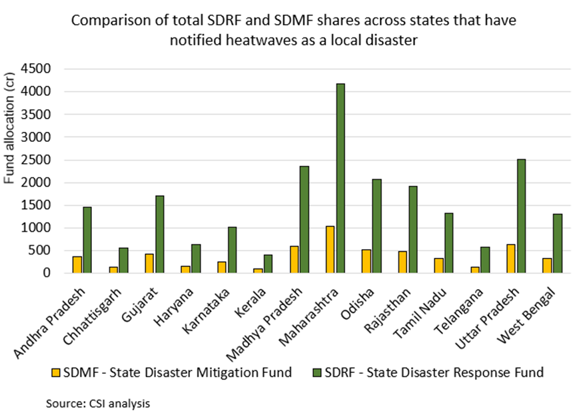
On the disaster financing side, since heatwaves are not yet included in the list of notified national disasters, states that notify them locally can access up to 10% of the allocations from both the State Disaster Response Fund (SDRF) and the State Disaster Mitigation Fund (SDMF). The establishment of the SDMF, following the recommendations of the 15th Finance Commission, created a formal financing window for pre-disaster mitigation and resilience-building. However, the broader allocation structure – where 80% of disaster funds are directed towards response and 20% towards mitigation – reflects a system that prioritises the response function over long-term risk reduction (Figure 1). The recommendations of the 16th Finance Commission in 2026 calling for the inclusion of heatwaves in the category of notified disasters, thereby unlocking access to the broader National Disaster Funds (for both response and mitigation) signal promise. Nevertheless, without the cost of heat-related interventions, it is difficult for those funds to be effectively captured and used.
The Emerging Financing Imperative
For a recurring, intensifying and predictable hazard such as extreme heat, these structural nuances carry important implications. As the expanded scope of heat action today looks to reduce future heat risk, the need to evolve the financing architecture to support these long-term objectives is growing. The challenge is not simply one of mobilising more funds but of developing the foundational understanding of the cost of heat resilience and institutional clarity needed to direct resources effectively.
Costing Long-Term Heat Resilience
What building long-term heat resilience means in practice and what financing systems must be prepared to support is becoming clearer. Many HAPs already point in this direction, proposing cooling shelters, urban greening, shaded public spaces, water bodies and changes to building design – measures that target how buildings, neighbourhoods and essential public systems manage heat before it becomes an emergency. Passive cooling may offer such a route, reducing heat gain and improving thermal comfort through building design, materials, shade, vegetation and air movement, with less dependence on energy-intensive mechanical cooling. In addition, some states are undertaking alternative approaches beyond HAPs. For instance, Tamil Nadu’s Heat Mitigation Strategy (2023) proposes viability gap funding for cool roofs and green infrastructure. Mumbai launched India’s first climate budgeting exercise in 2025, with heat-inclusive tagging (Brihanmumbai Municipal Corporation, 2026). Telangana’s Cool Roof Policy (2023-2028) expect institutional agencies to mobilise funds through HAPs for related initiatives.
Cool roofs are perhaps the most familiar intervention in this category, and material innovation is widening the options available. Much like clouds reflecting solar radiation into the atmosphere, cool roofs operate on the same principle of high albedo, bouncing sunlight away from surfaces. India’s Department of Science and Technology has recently highlighted an affordable radiative cooling paint developed for buildings, pavers, and tiles that reflects solar radiation and releases heat from surfaces without electricity. India’s Eco-Niwas Samhita also provides a policy foothold for natural ventilation and thermal performance. Measures for retrofitting essential public systems such as schools, anganwadis and other public buildings, where cool roofs, shading and ventilated design can reduce indoor heat exposure, present significant scope for targeted investments.
Cooling, however, does not stop at the building boundary. The physical infrastructure including roads, pavements, dense built-up surfaces, heat released from vehicles, and cooling systems contribute to the urban heat island effect and allowing high temperatures to persist into the evening and night according to a 2024 study on Urban Heat Island effect. Planned as part of a wider urban system, parks, tree-lined streets, green corridors and smaller neighbourhood green spaces can therefore help moderate local microclimates and limit heat accumulation across cities, as suggested by another study published in 2025. A scalable, systematic approach can also enable cost benchmarks. For instance, funding for cooling can be benchmarked against cooling targets and outcomes, such as cooling efficiency gains, relative to expenditure.
Blue-green infrastructure such as rain gardens, bioswales and sponge-parks further extends this logic. Permeable pavements allow water to pass through surfaces rather than being immediately channelled into drains. Combined with ponds, restored lakes, wetlands and recharge areas, these systems can support groundwater recharge and vegetation while creating cooler local environments.
The intrinsic value of these measures lies partly in their ability to address heat alongside flooding, water management and urban liveability rather than creating a separate infrastructure system for every climate risk. Such measures broaden the scope of what needs to be financed under a long-term heat resilience agenda and show why a uniform approach to heat investment may not work. The appropriate mix of interventions thus needs a detailed assessment of local heat exposure, urban form, existing infrastructure and the systems most at risk.
From Cost Estimates to Financing Pathways
Many of the heat-related investments already sit within the mandates of urban development, housing, health, water and municipal departments. The first question, therefore, is not always where to find a new source of finance, but what intervention is needed, where, at what scale and what it will cost. As NDMA officials have noted recently, without strategic costing, even well-designed plans risk degenerating into procurement exercises rather than coherent resilience frameworks. Identifying these needs at the planning stage and translating them into costed interventions can help determine what existing departmental schemes and budgets can support, how disaster mitigation funds can be deployed, and where dedicated or additional finance is required. In this sense, costing becomes the bridge between the long-term aspirations of HAPs and their implementation.
For cost estimates, a starting point to explore may be utilising city-level land records and property tax filing records. These records may be useful for a bottom-up costing and targeting layer to assess HAP interventions feeding directly into the budget-tagging and costing exercise. These can enable estimating cool roof and retrofit costing, identifying land availability for developing shaded public infrastructure, prioritising scope for urban greening, and prioritising and exploring potential incremental revenue instruments. These existing data records could be useful in designing incentive structures tied to cool roofing, etc., thereby suggesting demand-side financing levers rather than only a supply-side costing exercise. This, however, may require improvements in data quality and digitisation efforts, facilitating GIS integration and avenues for mainstreaming informal settlements in a city context.
Broadening the Financing Architecture
Furthermore, risk transfer strategies can be explored – for instance, parametric heat insurance. The Self-Employed Women’s Association (SEWA), in partnership with insurers and the Climate Resilience for All initiative, is piloting parametric heat insurance payouts for women informal workers in Gujarat and Rajasthan, triggered automatically by temperature thresholds rather than assessed losses. Mechanisms such as Forecast-based financing (FbF) can be designed to release an earmarked share from a pool when a heat forecast crosses a defined threshold, shifting money to the “before” side of the event rather than a post-disaster assessment exercise.
India’s experience with gender budgeting and climate budgeting, institutionalised in many states, suggests that expenditure tagging across departments is administratively feasible. India may also gain significantly from some international experience in this context. Vancouver’s Climate Adaptation Strategy (2024) links extreme heat actions to funded and unfunded investment needs across urban greening, cooling access, and building retrofits, indicating a forward-looking approach to financial planning by identifying future needs. California’s Extreme Heat Community Resilience Program (EHCRP) demonstrates how dedicated, grant-based financing can directly support local heat adaptation measures, such as urban greening and cooling infrastructure. The more recent WHO and UNDRR frameworks highlight the need to link HAPs to dedicated budget lines, assign clear institutional roles, and build capacity for monitoring and evaluation. Mediterranean cities such as Athens have created a position named “Chief Heat Officer” with budget lines tied to municipal capital plans, similar in spirit to Miami-Dade County’s Chief Heat Officer office, which pools municipal, philanthropic, and county funds into a single coordinating budget rather than leaving cooling/shade projects scattered across departments.
Institutional Coordination for Heat Resilience
For coordination, India needs to look to examples where a single statutory authority can exercise cross-departmental convergence powers. The “Chief Heat Officer” model emerging in other cities is a potential design question that India has yet to resolve, provided it can specifically address financing challenges.
Towards a Financing Framework for Long-Term Heat Resilience
As the scope of heat action has expanded, financing implementation and long-term resilience has emerged as a new frontier in India’s heat governance agenda. The first decade of India’s heat governance was defined by recognition and planning, with heat moving from the margins of policy to become an established concern within public health, disaster management and climate adaptation. Meeting the ambitions of this expanded agenda will require greater visibility of heat-related expenditure, and financing pathways capable of supporting risk reduction alongside disaster response. For India, the question is no longer only about planning for heat, but how to finance the transition from managing heatwaves as seasonal emergencies to building resilience against heat as a long-term climate risk.
The article is co-authored by Janhavi Bhujabal, Research Consultant and Honey Karun, Economist at Climate and Sustainability Initiative (CSI). Views expressed are personal.
Authors
-
Janhavi Bhujabal is a Consultant at the Climate and Sustainability Initiative (CSI), where she supports research and advisory work on climate risk, adaptation finance, policy, and heat resilience. Her work focuses on integrating climate data with policy insights to inform adaptation strategies and financing pathways, with a strong emphasis on translating technical analysis into actionable and scalable solutions.
Janhavi’s professional journey spans academic research, policy engagement, and applied climate risk analysis. She has built a strong foundation in climate science and modelling through postgraduate training and hands-on research in climate risk assessment, extreme weather analysis, and vulnerability studies. Before joining CSI, she gained experience in climate modelling and agro-climatic risk analysis in academic research settings, conducted primary field research on heat stress and vulnerability among outdoor workers, and supported legislative policy research on climate-adaptive agricultural practices. Across these roles, she worked extensively with climate datasets, field surveys, and policy briefs, bridging scientific evidence and policy design.
Janhavi joined CSI initially as a Policy Research Intern, where she contributed to climate policy mapping across more than a dozen Indian states. Her work involved analysing how key climate and green policy concepts are defined and operationalised across state policies and departments, supporting comparative assessments of subnational climate governance. She also contributed to climate data analysis for mining-intensive districts in Odisha, examining temperature and precipitation trends to identify extreme climate risks and associated economic vulnerabilities. In her current role, she is working on an urban heat risk, resilience, and financing project aimed at translating heat vulnerability analysis into implementable adaptation pathways.
Janhavi holds a Master of Science in Climate Science and Policy from the TERI School of Advanced Studies and a Bachelor of Science with a triple major in Physics, Chemistry, and Mathematics from CHRIST (Deemed to be University). Outside of work, she is a wildlife photographer and nature enthusiast who enjoys travelling and painting botanical watercolours. She speaks English, Hindi, and Oriya.
-
Honey Karun was an Economist at the Climate and Sustainability Initiative (CSI), where he led research on climate finance, policy instruments, and their macroeconomic implications. His work examined how climate action intersects with economic development, applying data-driven analysis and policy evaluation to generate insights that support evidence-based decision-making. At CSI, he developed policy briefs and analytical reports and contributed to dissemination efforts and collaborative policy dialogues with government, industry, and research stakeholders.
Honey had over a decade of experience across multilateral institutions, government agencies, and public policy think tanks, with a consistent focus on delivering policy-relevant economic analysis in complex institutional environments. His expertise spans climate-related policy design, fiscal governance, sustainable development, and applied macroeconomics. Before CSI, he served as an Advisor at the Quality Council of India, where he worked on sustainability and ESG policy research, including efforts to simplify ESG reporting frameworks for MSMEs and assess emerging global sustainability standards and their implications for India’s regulatory and economic landscape. Earlier in his career, Honey worked at the International Monetary Fund’s Resident Representative Office in India, supporting Article IV missions, preparing macro-fiscal briefs, analysing high-frequency economic indicators, and developing monthly economic dashboards for India and Bhutan. His role involved extensive coordination with government departments, regulatory institutions, public enterprises, and research organisations.
He has also contributed to international climate policy processes as a Consultant Associate Fellow at the CSEP Research Foundation, including co-authoring an input paper on non-price climate policies for the G20 Sustainable Finance Working Group during India’s G20 presidency. Honey holds an M.Phil. and an M.A. in Economics from Jawaharlal Nehru University and has completed advanced professional training on global governance and diplomacy in Germany. Outside of work, he enjoys travelling through the mountains on his motorcycle, spending time in nature, and is a committed advocate for animal welfare, particularly the well-being of dogs.