Did you know that in Chhattisgarh, a single grain—paddy—dictates the economic fate and daily livelihoods of nearly 80% of the population?
Today, agriculture remains the heartbeat of the state, contributing a significant 20.64% to the gross state domestic product (GSDP) at current prices. According to the latest economic survey of Chhattisgarh (2025–26), the agricultural sector is projected to grow by 7.49% in 2025–26 at constant prices. From the fertile central plains of Raipur to the sprawling fields of Janjgir–Champa, paddy is far more than just a crop; it accounts for 78% of Chhattisgarh’s total agricultural output, making it the backbone of the regional economy. Women play a crucial role in paddy cultivation, serving as the primary workforce in this sector. This is especially significant in the context of Chhattisgarh, where women account for 89–93% of the participation in paddy seedling activities, substantially exceeding men’s participation. However, with changing climatic conditions adversely impacting farming and farmers’ socio-economic status, this vital landscape is in flux. As climate change intensifies, the very identity of the “rice bowl” faces an unprecedented threat that requires an urgent strategic response.
The specialisation paradox: A deepening vulnerability
Chhattisgarh takes pride in its agricultural specialisation. Paddy currently occupies a staggering 75–80% of the gross cropped area, which is nearly double the national average in India. However, while this concentration was once a symbol of regional strength, it is now emerging as a significant economic risk. The state’s excessive dependency on paddy, a highly water-intensive crop (Directorate of Pulses Development, 2024), means that even a slight change in annual paddy cultivation patterns can have a significant impact on the state’s economy. Therefore, the key question is: At a time when the global and Indian agricultural sectors are transforming due to environmental changes, can Chhattisgarh truly afford to depend on a single crop?
A climate reality check: The shift from wet to dry
The biggest challenge for farmers at present is erratic and irregular rainfall. Hilly regions (in the north and the south), such as Sarguja and Bastar (Figure 1), remain relatively unaffected by climate change due to high forest cover and receive adequate precipitation. However, the principal rice-producing areas in the Bilaspur, Raipur, and Durg divisions experience significant rainfall deficits.
To understand the impact of changing rainfall patterns in the state, it is important to first understand Chhattisgarh’s geography. The state is divided into three main agro-climatic zones for cultivation. These three zones, along with the approximate percentage of paddy cultivated in those zones, are listed below:
- Chhattisgarh plains (51%): The central regions of the state are the “rice bowl” of the state, covering an area of 73 lakh ha. It includes districts such as Raipur, Durg, Bilaspur, and Rajnandgaon, where high-yielding rice varieties and intensive farming are common.
- Northern hills (28%): This zone, largely comprised of the Sarguja district, is primarily inhabited by tribal communities. This zone is known for cultivating ancient native varieties of aromatic, short-grained rice, such as the GI-tagged Jeeraphool cultivar.
- Bastar plateau (21%): The Bastar zone is also primarily inhabited by tribal communities. It features a plateau topography and has seen a 3.8% increase in paddy production in recent years due to improved, modern cultivation practices.
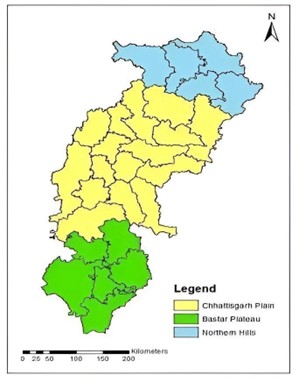
Figure 1: Pictorial description of the three agro-climatic zones for cultivation in Chhattisgarh. The yellow-shaded area represents the Chhattisgarh plains; the green-shaded area indicates the Bastar plateau; and the light blue-shaded area shows the northern hills.
According to a recent study, there has been no significant change in weather patterns or rainfall in the northern hills or the Bastar plateau; consequently, paddy production in these zones has not been significantly impacted. In contrast, the Chhattisgarh plains zone has been receiving erratic rainfall, resulting in a gradual decline in paddy cultivation since 2012 (Table 1).
| Region/metric | Average annual rainfall (approx.) | Status |
| National average | 1,800 mm | Baseline |
| Chhattisgarh state average | 1,300 mm | Lower than the national |
| Comparative analysis of the annual rainfall patterns across the three agro-climatic zones of Chhattisgarh | ||
| Northern hills | 1,250–1,450 mm | Below the national average, but converges on the state average |
| Chhattisgarh plains | 1,000–1,250 mm | Below both the national and the state averages |
| Bastar plateau | 1,300–1,600 mm | Below the national average, but above the state average |
Table 1: Regional rainfall disparity in Chhattisgarh.
Source: Indira Gandhi Krishi Vishwavidyalay, agrometeorology department; Directorate of Economics and Statistics, Government of Chhattisgarh (2023–24); Ministry of Agriculture and Farmer Welfare, district-wise crop area statistics
In specific instances, production losses across major crops have been as high as 41%, with average yield declines of 15%. Meanwhile, reports say that Chhattisgarh’s paddy yield is highly correlated with climate shifts, particularly rising temperatures. According to a study named District-level Assessment of Climate Change Impacts on Rice Yield in Chhattisgarh by Gowtham S and Dhanapriya M in 2025, in the long run, a 1% increase in the maximum temperature is projected to cause a significant 1.64% decrease in paddy yields. Conversely, although increased rainfall can help, its positive impact on paddy cultivation is much smaller. For instance, a 1% increase in annual rainfall will boost yields by only 0.31%. Therefore, it is clear that additional rainfall is insufficient to offset the damage caused by heat. The study also indicates a “speed of adjustment” of 43%, meaning that when weather shocks occur, the system nearly halves their impact within a year and further reduces it by about half in the following year. To understand the meaning of “speed of adjustment” and why authors of the research paper mentioned above say the system “nearly halves the impact” every year, let us take a hypothetical example:
Year 0 (The Shock): Let us consider that a severe drought occurs. It causes a 100-unit drop in rice production below the expected long-term travel. The impact is currently 100.
Year 1(First Adjustment): The system adjusts by 43%
- Adjustment: 43% of 100 = 43 units
- Remaining impact: 100-43=57
- Result: The impact is nearly halved (reduced from 100 to 57)
Year 2 (Second Adjustment): The system adjusts by 43% of the remaining gap
- Adjustment: 43% of 57 ~ 24.5 units
- Remaining Impact: 57-24.5 units=32.5 units
- Result: The impact is again nearly halved (reduced from 57 to 32.5 units)
Furthermore, one more conclusion that can be drawn is that since agriculture accounts for nearly a fifth of Chhattisgarh’s total economy (GSDP), declines in yield could lead to a significant reduction in the state’s wealth over time.
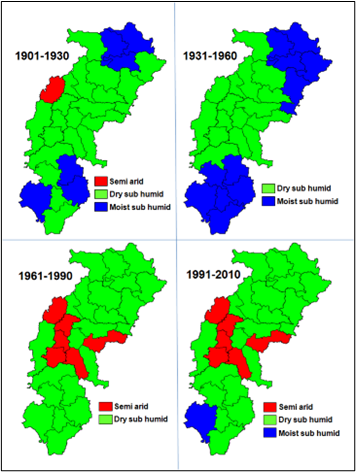
Figure 2: Pictorial representation of the changing pattern of rainfall in Chhattisgarh over the decades. The number of semi-arid areas in the state has increased from one district to six, indicating that the state is moving from a wet to a dry climate.
Source: Abhishek Danodia, Impact on Weather Resources and Agriculture in Chhattisgarh State (2013), Department of Agrometeorology, Indira Gandhi Agriculture University, Raipur.
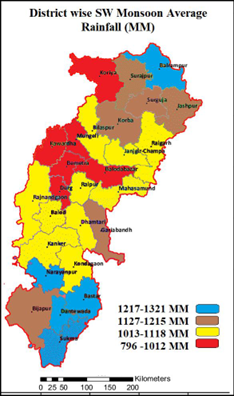
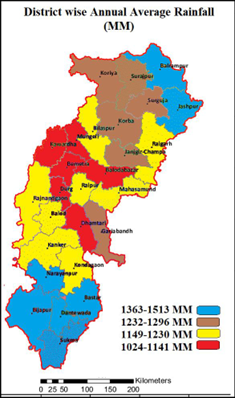
Figure 3: Mean pattern of the southwest monsoon over the districts. Figure 4: Mean pattern of annual rainfall over districts.
Source: Department of Agrometeorology, Indira Gandhi Agriculture University, Raipur.
A roadmap to resilience: The path forward
To address erratic rainfall amid changing climatic conditions and maintain the state’s paddy yields, experts and researchers in Chhattisgarh, including those at Indira Gandhi Agricultural University, have suggested that the state adopt the following multi-pronged strategy.
● Transition to climate–smart agriculture: Traditional rice farming involves growing seedlings in a nursery and then transplanting them into flooded fields. The use of direct-seeded rice (DSR) skips this process; the seeds are sown directly into the soil with a tractor-mounted machine. The adoption of direct-seeded rice reduces water consumption by approximately 20–25% and lowers methane emissions (a major greenhouse gas) as the fields are not constantly submerged. It also saves labour costs significantly. It can also help sustain rice production while reducing water use and maintaining groundwater levels. Punjab and Haryana offer good examples of states that have successfully shifted to DSR, resulting in water conservation and reduced labour costs.
● Adopt smarter water management: Large-scale implementation of rainwater harvesting is not only critical, but also an investment in decentralising water infrastructure. This involves constructing ponds on farms and promoting micro-irrigation systems, such as drip and sprinkler technologies. During periods of low rainfall, the water stored in these ponds can be used for paddy irrigation, reducing the risk of lower yields. During dry spells, it is also essential to strengthen groundwater monitoring systems. This will help in preventing the overexploitation of aquifers. Such measures can particularly help states such as Chhattisgarh, which are largely rain-fed.
● Offer technology-driven support systems: By adopting a “tech-first” approach, the state can protect upcoming paddy cultivation and avoid losses. For instance, in the northern hills and Bastar plateau, the state can use early warning systems—similar to those deployed in Odisha—to alert farmers to harvest early in case there is a threat of storms or floods. In the Chhattisgarh plains, the state can install automated weather support (AWS) at the village level, allowing farmers to access real-time data on soil moisture and humidity. This would ensure that farmers use water or fertilisers only when necessary, eliminating complete dependency on abundant water to secure paddy production. Such measures have been extremely beneficial to farmers in Maharashtra (The Better India, 2017). Although Chhattisgarh has recently begun adopting AI-driven weather-monitoring systems (PTI, 2026), the state needs to expedite its implementation to support the upcoming paddy cultivation season (rabi).
Conclusion: A call to action
The shifting weather of Chhattisgarh, “the rice bowl of India”, serves as a critical economic warning not only for the state’s economy but also for farmers’ incomes. With nearly 80% of the farming population dependent on a single, water-intensive grain, the state can no longer rely on traditional methods in an era of climatic volatility. To protect the livelihoods of the millions who form the backbone of this sector, particularly the women who provide the majority of labour in seeding activities, the state must take strong measures to safeguard its identity and also sustain the livelihoods of thousands of farmers.
This requires a rapid transition to a “tech-first” agricultural model. By institutionalising DSR to reduce water use by 25% and accelerating the deployment of AI-driven AWS, the vulnerable agro-climatic zone of the central plains of Chhattisgarh can decouple its economic fate from erratic monsoons.
By Rohit Mukherjee, Consultant, Climate and Sustainability Initiative (CSI). Views expressed are personal.