Heat action plans (HAPs) have rapidly proliferated across Indian cities, reflecting growing recognition that extreme heat is a governance challenge that requires a coordinated response. As discussed earlier in this series, while these plans have improved in scope, questions remain about how effectively they are implemented and sustained. This blog turns to a critical and often under-investigated aspect of this governance challenge: financing. It examines how heat action under HAPs is currently financed in India, the structural gaps in existing systems, and what can be learned from international experience in funding heat resilience.
How heat action is currently financed in India
Guided by the National Disaster Management Authority (NDMA), [1] HAPs outline a coordinated, multisectoral approach to managing extreme heat. These guidelines allow states the flexibility to use their state disaster response funds (SDRF) [2] and recognise drawing on departmental budget allocations, alongside urban planning, as an enduring strategy for reducing heat risk. SDRFs primarily support immediate response measures such as temporary cooling arrangements or relief support [3] rather than long-term risk reduction.
In practice, financing is not articulated explicitly. HAPs function as operational coordination documents (rather than fiscal instruments), directing departmental actions and implying the use of funds from existing budgets (disaster management, municipal, and scheme-based) for implementation. [4]
Municipal and sectoral budgets form the backbone of financing for heat-related interventions, even though heat is not structured as a distinct category. Measures such as establishing green spaces and water facilities in public areas are funded by the public works, environmental, and urban departments. Heat-related interventions are therefore embedded within broader budgets, competing with priorities such as sewage, transport, and housing. [5] Meanwhile, schemes such as AMRUT 2.0, the Smart Cities Mission, the National Health Mission, and Ayushman Bharat [6] support heat resilience more effectively. Recent analyses [7] suggest that multiple centrally sponsored schemes already finance interventions aligned with heat mitigation and adaptation. However, implementation depends on alignment with existing programme objectives rather than heat-specific mandates; [8] hence, expenditure may not be traceable or predictable, as provisions remain uncosted (BehanBox, 2025).
Beyond HAPs, some states are taking different approaches. Tamil Nadu’s Heat Mitigation Strategy (2023) proposes viability gap funding [9] for cool roofs and green infrastructure. Maharashtra launched India’s first climate budget in 2025, with heat-inclusive tagging (Brihanmumbai Municipal Corporation, 2026). Emerging approaches, such as Telangana’s Cool Roof Policy (2023–2028), expect institutional agencies to mobilise funds through HAPs for related initiatives.[10] Bhubaneswar’s Integrated Heat and Cooling Action Plan (2025) emphasises departmental budgeting for heat resilience, structured risk financing, and the use of proposed financing models for mitigation.[11] Such approaches promise innovation but have yet to scale.
Understanding the structural gaps
In India’s current financing landscape, financing for heat governance is shaped by the country’s institutional design. Heatwaves are not formally recognised as disasters under the Disaster Management Act (2005), [12] meaning that state response to them depends on individual states categorising them as disasters to unlock 10% of SDRF funds. This also creates a bias towards post-disaster spending. [13] At the same time, as HAPs lack the authority of fiscal instruments to allocate funds, they can at best mobilise resources from departmental budgets—as highlighted in Telangana’s example[14]—but this approach is not followed consistently across plans.
Since spending decisions sit outside these plans, pre-emptive heat measures compete with other departmental and scheme priorities and lack systematic tracking and costing. As a result, their visibility and implementation remain uneven (Saumya Kalia, 2025). This creates a disconnect: while HAPs recognise the need for long-term resilience, financing structures remain largely ad hoc and reactive (BehanBox, 2025).
What global approaches show
Against this backdrop, cities and regions across the globe are adopting new approaches towards financing heat resilience that combine planning, budgeting, and dedicated funding. Vancouver’s Climate Adaptation Strategy (2024) links extreme heat actions to funded and unfunded investment needs across urban greening, cooling access, and building retrofits, indicating a forward-looking approach[15] to financial planning by identifying future needs. Vancouver’s approach is reinforced by the city’s climate budget (2025), which links it to identified funding sources,[16] such as the Union of British Columbia Municipalities (UBCM) Disaster Risk Reduction Fund. Freetown demonstrates how cities with limited fiscal space are innovating [17] using blended finance—drawing on adaptation funds, microfinance, and insurance—to support heat illness treatment and strengthen community resilience. While not part of a planning document, California’s Extreme Heat Community Resilience Program (EHCRP) shows how dedicated, grant-based financing can directly support local heat adaptation measures such as urban greening and cooling infrastructure for communities (CA Governor’s Office of Land Use and Climate Innovation, n.d.).[18]
Taken together, these approaches show how heat resilience can be financed beyond emergency responses through clearer budgeting and more diverse funding. At the same time, global guidance—such as the World Health Organization’s guidance on health adaptation to heat (WHO, 2021) and the United Nations Office for Disaster Risk Reduction’s Extreme Heat Risk Governance Framework and Toolkit (UNDRR, 2025)—calls for linking HAPs to dedicated budget lines or aligning them with funding mechanisms for implementing agencies. It also emphasises the need for clear roles, monitoring and evaluation, and targeted interventions as heat adaptation evolves. The Heat Action Platform’s Fund and Finance Heat Action module reinforces this by providing a framework that maps heat‑adaptation measures (such as cooling centres, shaded public spaces, and urban greening) to municipal budgets, climate‑resilience funds, and other public‑finance instruments (Atlantic Council and Climate Resilience Center, n.d.). It highlights the need for explicit funding‑channel planning to turn heat‑intervention plans into action.
What does this mean for India?
For India, the gap between current practice and what global examples illustrate is not just about increasing funding but about how existing and potential funds are accessed and structured within institutionalised plans. As HAPs in India move beyond early warning towards strengthening climate-responsive infrastructure, funding needs to keep pace by shifting from a disaster-response lens to an adaptation priority.
The Cities Climate Finance Leadership Alliance notes that most HAPs do not present their proposed interventions as costed, “fundable projects” (CCFLA, 2025). This makes it difficult to assess how much can be covered through existing departmental allocations, central schemes, and disaster budgets and how much additional funding is needed. The challenge is compounded by the fact that department heads are responsible for implementing the interventions outlined in HAPs. This gap becomes particularly important when states rely on disaster funds.[19] For instance, Telangana’s HAP points to the use of state disaster funds for mitigation and response.[20] If we consider the previous year’s allocations—approximately ₹582 crore from the SDRF and ₹145 crore from the state disaster mitigation fund (SDMF)[21] to the state disaster management authority (SDMA)—the amount available for managing locally notified disasters, such as heatwaves and lightning strikes, was roughly ₹58.2 crore and ₹14.5 crore for relief and mitigation activities, respectively. This pool must cover multiple disasters, not just heatwaves. For a population of 3.87 crore, [22] this translates to roughly ₹3.75 per person for pre-heatwave preparedness activities. This reveals two key points. First, a needs-based assessment is essential to quantify the cost of heat mitigation activities during planning. Second, the HAP allocates more to post-disaster response than to long-term mitigation, which guides how these funds are used.
The immediate opportunity lies in budget tagging, costing, clearly identifying investment requirements, and establishing implementation-ready funding streams. As the World Bank (2021) notes, budget tagging helps to identify climate-related outputs in the budget, evaluate implemented activities, and track funds used for climate-related interventions—therefore, by extension, it supports heat mitigation efforts as well. Furthermore, costing heat-related interventions and mapping them to existing central and departmental schemes that finance heat-related activities helps ensure the judicious use of existing budgets and can help transition HAPs’ heat-mitigation measures from aspirational commitments to implementation-ready projects (CPR, 2023).[23] Lastly, designating budget heads to ensure and track implementation progress is critical for accountability. In practice, this improves visibility across departments and makes it easier to align HAPs with existing public finance flows, while identifying where additional funds are needed—especially when departments are entrusted with added responsibilities. [24]
Lastly, as public finance remains the primary source of funding for HAP interventions, cities and municipalities with limited fiscal space may need to rely on a more diversified mix of instruments, as demonstrated by Freetown’s blended finance approach. Some of these approaches are already emerging in India—such as climate budget tagging in Maharashtra [25] and early efforts in Bhubaneswar to make heat interventions more fundable—suggesting the emergence of models that can be adapted and scaled. At the same time, emerging disaster mitigation windows under the NDMA could strengthen support for long-term resilience financing, especially if the recommendations of the 16th Finance Commission are implemented. [26]
Conclusion
India’s heat governance has come a long way. Policy recognition has grown, planning frameworks have expanded, and HAPs have become a standard feature of urban administration across the country.
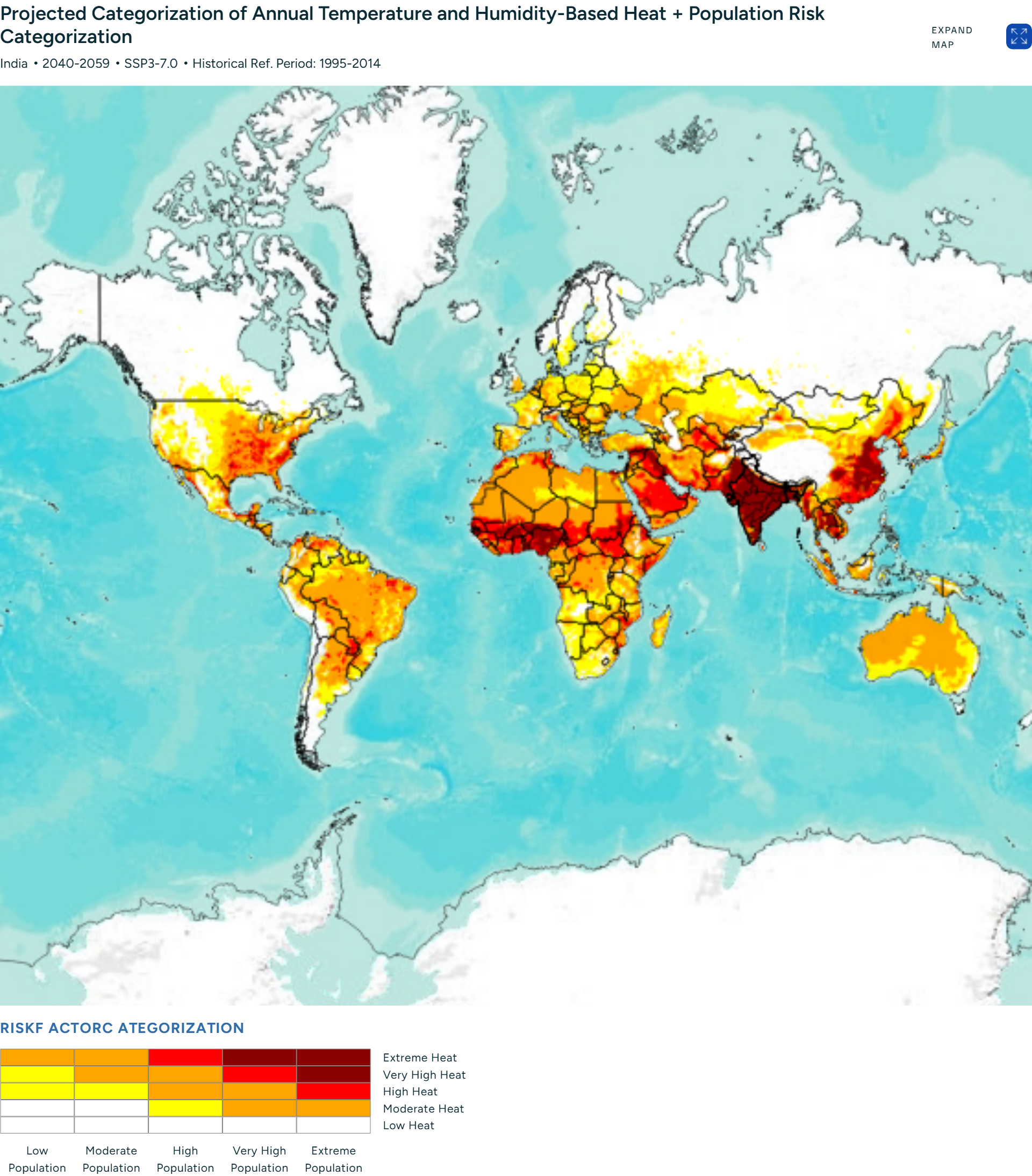
Figure 1. Projected heat and population risk exposure in the near future (2040–2059) under a medium- to high-emission pathway (Shared Socioeconomic Pathway 3-7.0 (SSP3-7.0)) shows that large parts of India fall within high to very high heat risk zones, often overlapping with densely populated regions. Compared with the rest of the globe, this concentration is likely to intensify human vulnerability and economic risks, which must be addressed through planned investment in heat resilience. Source: World Bank Climate Knowledge Portal (n.d.); analysis supported by recent estimates of heat-related productivity losses (Policy Circle, 2024)
Yet, as long as heat action relies on reactive disaster funds, uncoordinated scheme convergence, and uncosted interventions, the gap between what HAPs plan and what cities can deliver will persist. Looking ahead, this gap will become even more critical. Figure 1 shows that future heat risk in India is expected to intensify more than globally, with large parts of the country facing overlapping exposure to rising temperatures, humidity, and population density.
HAPs will therefore need a broader assessment of needs across short-, medium-, and long-term measures to ensure a consistent flow of funding for implementation. The shift from plans that coordinate to plans that implement is not just a technical adjustment but a change in how heat is understood: not as a seasonal emergency but as a foreseeable risk to invest in.
By Janhavi Bhujabal, Consultant, Climate and Sustainability Initiative (CSI). Views expressed are personal.
Endnotes
[1] With reference to the NDMA guidelines (2017; 2019) for preparing heat action plans (HAPs), which are followed by HAP authorities.
[2] According to the NDMA 2017 guidelines, state governments may use up to 10% of the SDRF to provide immediate relief for locally notified disasters, including heatwaves, subject to state notification and approved norms (NDMA, 2017).
[3] For example, the Government of Tamil Nadu notified “heatwaves” as a state-specific disaster to unlock funds for relief measures, including ex gratia payments of ₹4 lakh per heatwave death following extreme heat episodes in 2024 (DT Next, 2024).
[4] For example, in Ahmedabad’s HAP, the early warning system mandates that departments allocate funds for heatwave management (NRDC, 2019).
[5] The Delhi FY26–27 budget (₹1,03,700 crore) allocates 21% to environmental protection and green initiatives but includes no dedicated budget line for heat action. Greening activities share allocations within the Public Works Department (₹5,921 crore) and Department of Urban Development (₹7,887 crore), alongside competing priorities such as sewage and water management (Verma, 2026).
[6] Under AMRUT 2.0, urban green spaces and water rejuvenation projects have been sanctioned (Ministry of Housing & Urban Affairs, 2024). Under Jaipur’s Smart City proposal, cool and green tourist corridors—with aromatic mist spray systems and shaded pedestrian walkways—have been proposed (Smart City Jaipur, n.d.). The National Health Mission supports the implementation of heatstroke treatment protocols, oral rehydration solution (ORS) corners, and emergency cooling measures (such as ice packs and fans) under the National Action Plan on Heat Related Illnesses. Ayushman Bharat also expands primary care to include heat illness management at health and wellness centres (Ministry of Health &Family Welfare, 2021).
[7] The Centre for Policy Research (2023) identifies approximately 18 centrally sponsored schemes with components such as water management, housing, and public health systems that are relevant to heat resilience but have not yet been classified as heat-related expenditures.
[8] This excludes programmes under the National Health Mission (2017) and Ayushman Bharat (2021).
[9] The Tamil Nadu Heat Mitigation Strategy (2023) proposes government top-up funding to attract private capital for projects such as cool roofs by covering the gap between costs and private returns.
[10] The policy states that city-level agencies responsible for the implementation and institutional coordination of cool roof initiatives should mobilise funds through HAPs, particularly for low-income housing, and subsequently submit implementation reports.
[11] The plan highlights that urban greening is being driven under the AMRUT scheme, while cool roofs have yet to receive dedicated initiatives. It therefore suggests a unified urban cooling policy to move beyond ad hoc efforts, alongside sustainable budgeting and provisions for maintenance to support long-term heat adaptation. The plan also introduces parametric insurance for vulnerable workers, supported by hybrid funding models that combine public subsidies with donor support. On the mitigation side, it proposes microfinance support, targeted subsidies, and community-led financing for cool roofs, energy-efficient appliances, and building compliance. Lastly, it attempts a partial costing of cool roofs (₹33 crore for scaling the intervention across slum households in the city) and highlights the need for several hundred crores to scale up investment.
[12] Print media (Sinha A, 2019) reports that the exclusion of heatwaves from Disaster Management act 2005 during its conception as they were then viewed as common summer events. Beyond this, for the 15th Finance Commission two key reasons persisted: 1) absence of definitions for heat related fatalities or economic damage and 2) potential strain on National Disaster Response Fund from compensation liabilities due to which they withheld recommending it’s inclusion.
[13] Addressed in a previous blog in this series (Bhujabal J., 2026) and in footnote [2].
[14] As highlighted earlier, the state’s Cool Roof Policy (2023) expects departments to mobilise resources through HAPs. In the draft state heat action plan (2024), funding mechanisms are explicitly mentioned, including mobilisation from different sources (corporate social responsibility (CSR), departmental budgets, and specific rather than assumed schemes).
[15] Vancouver’s Climate Change Adaptation Strategy (2025) links extreme heat actions to the city’s capital planning by identifying both funded and unfunded investments across urban greening, building retrofits, and access to cooling. For 2023–2026, capital allocations related to heat action include investments in urban forestry (e.g., $2.5–5 million) and building energy retrofits (e.g., $24 million), alongside $5 million earmarked for emerging extreme heat initiatives. The strategy further estimates that $16.3 million in capital is needed for extreme heat actions and identifies additional unfunded measures to be taken up in future budget cycles, signalling a forward-looking approach to planning and financing heat resilience.
[16] The City of Vancouver Climate Budget Memo (2025) allocates USD 3.2 million for measures addressing extreme heat and air quality, including urban tree planting and facility upgrades. It also secures USD 5.3 million in external grant funding for infrastructure improvements at community centres to support responses to extreme heat. In addition, the memo identifies a pipeline of approximately USD 28 million in grant applications for tree-planting and indoor-cooling initiatives.
[17] The Freetown Heat Action Plan (2025) aims to mobilise USD 10 million in seed funding by 2028, focusing on the 35% of residents living in 82 informal settlements who face high heat exposure. The city’s blended finance approach combines international climate finance—from organisations such as the Arsht-Rock Resilience Center and Climate Resilience for All—with microfinance (MiKashBoks) and local insurance schemes. This approach particularly supports women in investing in cooling solutions and protecting themselves against climate-related losses.
[18] The Extreme Heat and Community Resilience Program (EHCRP), administered by the Governor’s Office of Land Use and Climate Innovation, allocates dedicated grants—USD 32 million announced in 2025—to fund local heat adaptation measures such as tree canopies, urban greening, cooling centres, and home retrofits. These efforts aim to support equity-focused heat–health responses.
[19] According to the National Disaster Management Authority guidelines (NDMA, 2017) on creating HAPs, state disaster funds may be used conditionally to support their implementation. The recommendations of the 15th Finance Commission led to the operationalisation of state disaster risk management funds (SDRMFs) for 2021–2026. Of this allocation, 80% is channelled to the state disaster response funds (SDRFs) and 20% to state disaster mitigation fund (SDMFs), marking the first formal, mitigation‑specific funding window at the state level (NDMA, n.d.). Identical to the mandate allowing states access to 10% of the SDRF for relief operations related to locally notified disasters, 10% of the SDMF is available for long-term, pre-disaster mitigation activities (MHA, 2025).
[20] The Telangana State Heatwave Action Plan (2021) states that “the SDMA shall allocate funds from SDRF for the plan implementation including preparedness, capacity building mitigation activities (long term and short term)”.
[21] Telangana’s SDRF and SDMF allocations are listed in the Ministry of Home Affairs reply and the NDMA-uploaded allocation table, which provide the state-wise figures for 2025–2026 used here (MHA, 2025; NDMA, 2026).
[22] The population count refers to the projected population figure for the state of Telangana, based on the Report of the Technical Group on Population Projections for India and States 2011–2036 (NHM, 2019).
[23] CPR’s mapping of heat-resilience solutions against existing state and central schemes shows how HAPs can align proposed measures with available public finance, making existing budgets more usable for implementation.
[24] iFOREST Global (n.d.), in its case study of Delhi’s Heat Action Plan, notes that while several new responsibilities (training, ORS kits, changes to labour hours, etc.) have been allocated to the labour department, there are no additional fiscal allocations to support them.
[25] There is an explicit mention of creating urban green spaces to reduce the urban heat island effect as a line item in Maharashtra’s Climate Budget (2025–26).
[26] The 16th Finance Commission has recommended including heatwaves among notified disasters under the Disaster Management Act, 2005 in response to growing demand as 11 states have recognised heatwaves as a locally notified disasters (Down to Earth, 2026). This move would enable states to access central‑level instruments such as the NDRF and the National Disaster Mitigation Fund (NDMF) for both emergency relief and long‑term heat‑resilience projects.