There is no dearth of green finance figures in India, as multiple trackers publish credible estimates of climate finance flows, making the discourse well-informed. However, while a number tells us how much has been deployed, it rarely explains why capital falls short in some sectors more than in others. Granular information is also lacking about how much climate finance costs, what tenors it is available for, or what stakeholders plan to do next. For a country like India, which has set ambitious climate goals for 2030, these questions become pertinent.
India has committed to net-zero emissions by 2070. By 2030, it aims to cut the emissions intensity of its GDP by 45% from 2005 levels, avoid one billion tonnes of projected emissions, meet 50% of its energy requirements from renewable sources and reach 500 GW of non-fossil capacity (Government of India, 2022). India’s net-zero transition requires a cumulative investment of USD 15–20 trillion by 2070, translating to USD 300–400 billion per year (NITI Aayog, 2026). These substantial figures imply that no single funding source can meet this funding requirement and underscore the need for coordinated action by all stakeholders in the financial system.
Green finance is not one pool of money
It is too simplistic to consider climate finance a single pool of funds, since very different actors operate in this domain. This is precisely why the question of climate finance is so complex and demands granular analysis.
Banks and Non-Banking Financial Companies (NBFCs) lend against their balance sheets, while institutional investors have their own return expectations. Likewise, private equity and venture capital finance new technologies but require an exit plan, while foreign investors are exposed to exchange-rate risk. Both governments and Development Finance Institutions (DFIs) provide patient and catalytic capital, but with some limitations. Each financier has its own risk tolerance and price level, and bundling them into a single category obscures these differences. Moreover, the transition may stall if the wrong mix of capital is used, even when the total finance mobilised looks healthy. Therefore, it is essential to understand whether the available finance and financial instruments are appropriate for the investments that need them.
The financing gap is not only a capital shortage
The demand side is equally complex, with multiple actors having varied needs. Power, green hydrogen, industrial decarbonisation, electric mobility and low-carbon manufacturing all require different permutations and combinations of capital in terms of nature, tenor and price. However, the need for financing does not automatically translate into an investable project. Between each need and a financed project lie technology risk, policy uncertainty, currency risk, uncertain revenues and asset–liability mismatches. Hence, a financing gap may not necessarily be only a shortage problem but could also be a matching problem. Money may exist yet fail to reach a project due to high perceived risk or a temporal mismatch, and getting this diagnosis right is essential to prescribing the right remedy.
Policy does not guarantee capital flow
Regulators and statutory bodies, including the Reserve Bank of India (RBI), the Securities and Exchange Board of India (SEBI), the Pension Fund Regulatory and Development Authority (PFRDA), the Insurance Regulatory and Development Authority of India (IRDAI) and the Employees’ Provident Fund Organisation (EPFO), are shaping how financial institutions treat sustainability, while government budgets and international climate finance provide grants, incentives, subsidies and conditionalities. Each intervention is expected to shift capital and influence the ecosystem. However, to gauge the impact of any regulation, it is important to map the chain from the regulator to the financial institution to the instrument to the real-economy outcome. Without tracing this chain, it is difficult to know whether a policy intervention is actually improving capital allocation or just adding another layer to the financial architecture.
Beyond the numbers
The instinctive approach to understanding the entire climate finance ecosystem is to model it. Financial databases and reports can help establish trends and volumes. However, data is backward-looking, and models rest on assumptions; this is where qualitative evidence can fill the gaps. Market actors sense shifts before they appear in statistics. Stakeholder consultations, including structured interviews with regulators, financial experts, developers and policymakers, can help surface information that no dataset records.
The two approaches can augment each other. While numbers show how much capital is moving, qualitative evidence explains why. Numbers reveal the bottleneck, while stakeholders reveal where it stems from: risk, policy or structure. Therefore, combining quantitative and qualitative approaches can provide a comprehensive explanation of how climate finance needs to be re-anchored to real-economy investment needs.
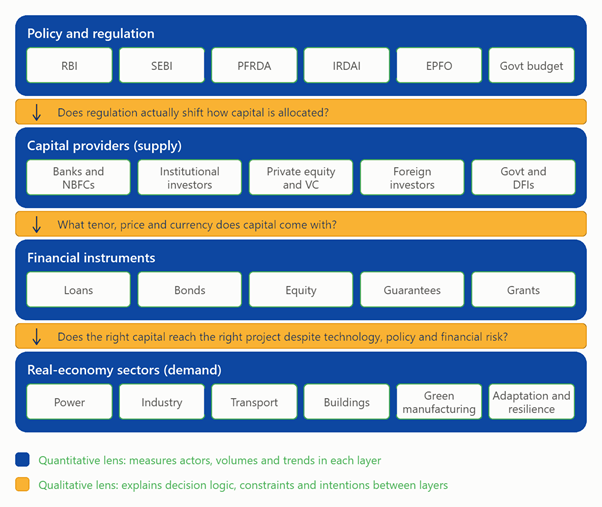
Figure 1: Mapping India’s Green Finance Landscape. Source: Author’s illustration with AI assistance
The missing picture and the way forward
Everyone in the system needs the full picture of the green finance landscape, yet no one is positioned to compile it. Policymakers focus on schemes, banks on books, investors on portfolios and regulators on regulations and guidelines. The more the market grows and diversifies, the harder it becomes to see the whole picture. A transition this significant requires a holistic, regularly updated reading of the market. It is essential to analyse demand and supply side by side, drawing on the voices of those who move capital and looking both forward and back.
This is perhaps where an annual outlook on green finance can fill this gap by bringing together fragmented data and combining quantitative evidence with qualitative insights to look beyond where capital has flowed and to assess what the future financing landscape needs to look like to support India’s green transition. Until then, India’s targets will remain clearer than the path to funding them. If we cannot yet answer how, where and why capital is (or is not) flowing, how can we expect it to arrive at the scale and pace required?
References
Government of India. (2022). India’s updated first nationally determined contribution under Paris Agreement (2021–2030). United Nations Framework Convention on Climate Change. https://unfccc.int/sites/default/files/NDC/2022-08/India%20Updated%20First%20Nationally%20Determined%20Contrib.pdf
NITI Aayog. (2026). A study report on scenarios towards Viksit Bharat and net zero: An overview (Vol. 1). Government of India. https://www.niti.gov.in/sites/default/files/2026-02/Scenarios-Towards-Viksit-Bharat-and-Net-Zero-%20An-Overview-Vol1.pdf