The global transition to green energy technologies is driving significant demand for key critical minerals (e.g., lithium, nickel, cobalt, copper, graphite and rare earths). The International Energy Agency (IEA) estimates a multi-fold increase in the demand for these minerals by 2050 (Figure 1).
More importantly, critical minerals are viewed as alternative energy inputs compared to conventional inputs such as coal and other fossil fuels. These critical minerals are thus strategic assets for the next generation of energy infrastructure, and will determine energy security, industrial competitiveness and geopolitical influence.
While many critical minerals are abundant in the Earth’s crust, historical underdevelopment and underinvestment in infrastructure have led to supply constraints, necessitating the expansion of the critical minerals value chain (the mining and processing stages, in particular).
Figure 1. Demand for key critical minerals
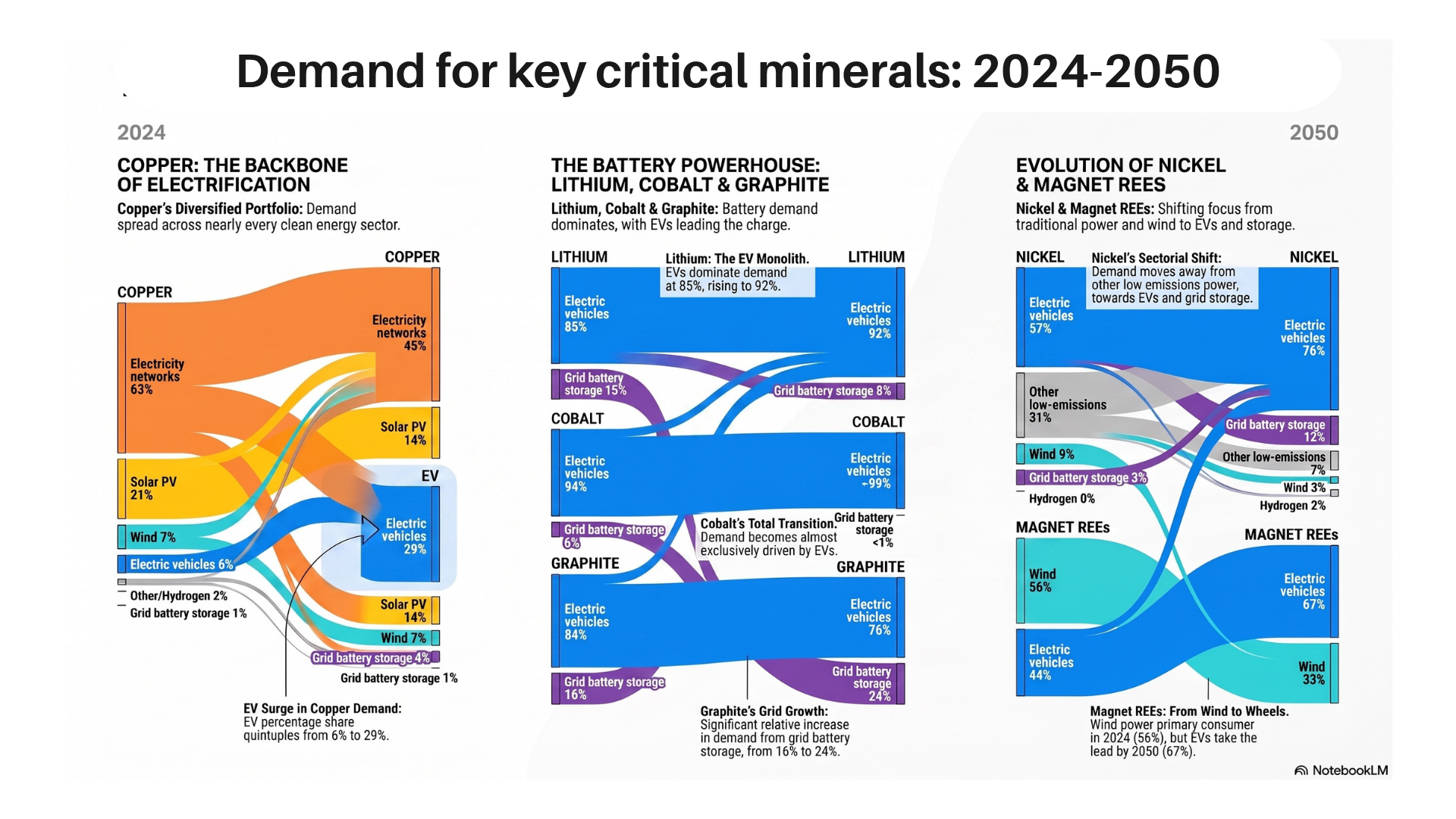
Source: International Energy Agency
However, the challenge lies not just in expanding the production and application of these critical minerals. Rather, the broader question is which stages of the critical minerals value chain should be developed domestically and what should remain integrated in the value chain?
Answers to these questions, in turn, will determine not just mining and processing operations, but also decide who captures the economic value generated and who bears the social and environmental costs associated with the extraction and processing of these minerals. At present, access to these minerals relies on a complex supply chain – spanning mining, processing, manufacturing and recycling – and each segment represents different economic opportunities as well as environmental and social costs.
For resource-rich countries, this presents a unique opportunity to move beyond resource extraction and to promote industrialisation by developing processing and manufacturing plants. However, mining and processing are both environmentally intensive processes, requiring huge amounts of land, water, chemical and energy inputs. Thus, increased production can lead to accelerated environmental degradation, as well as additional concerns around labour rights and community-level impacts.
Governments, therefore, must grapple with complex trade-offs between securing stable raw materials, promoting industrial development and safeguarding the rights and livelihoods of local and Indigenous communities. The central question is no longer whether countries can produce enough critical minerals to power a transition to clean energy, but how they can govern their extraction and processing to balance mineral security, industrial transformation and environmental and social justice.
The unequal geography of critical minerals
The costs and benefits of this transition are distributed disproportionately. Mineral extraction is concentrated in resource-rich countries such as Argentina, Bolivia and Chile (the lithium triangle) and Indonesia. However, the most value-adding stages – processing and refining – are situated in advanced economies, particularly China. For instance, Indonesia extracts 44.3% of the world’s nickel (USGS, 2026), while Chinese companies refine 75% of the nickel in Indonesia (Visual Capitalist, 2026). This geographic separation of the value chain means that resource-rich countries often bear an inequitable share of the social and environmental impacts associated with mineral extraction. Meanwhile, much of the economic value generated by such processing is captured elsewhere.
This unequal geographical distribution raises some broader questions: Should resource-rich countries remain suppliers of raw materials, or should they seek to capture more of the economic and industrial value of their resources by developing processing and manufacturing capacities? These considerations are increasingly shaping policies across both developed and developing nations.
Trade-offs from domestic value addition
At the mining stage, the social and environmental challenges associated with extraction vary across minerals and geographies. In Chile and Argentina, large-scale brine-based lithium extraction is associated with significant groundwater depletion and the generation of acid mine waste, altering the region’s hydrogeochemical balance and posing risks to water-based ecosystems (Sahoo, 2026).
Whereas the Australian hard-rock spodumene mining creates a different footprint – using water during beneficiation process while driving sizable land disturbances and higher carbon emissions from energy intensive crushing and processing of the ore (Sahoo, 2026).. Similarly, in Indonesia, nickel mining has resulted in deforestation and high carbon emissions, while also affecting communities with fishing-based livelihoods and increasing pollution (Sahoo, 2026).
These examples illustrate that the social and environmental problems in each geography depend on the mineral involved, the extraction method and the local context. This implies governance approaches must be adaptive to local ecological conditions as well as labour and community rights.
While mining alters landscapes and affects surrounding communities, critical mineral processing presents its own distinct challenges. It is highly energy-intensive, involving complex processes such as hydrometallurgy and pyrometallurgy, which consume large amounts of electricity and chemical solvents. Processing minerals to extract metals such as nickel, copper and tin generates acidic effluents and hazardous waste; it also releases pollutants such as the oxides of sulphur and nitrogen (SOx and NOx), as well as arsenic, lead and mercury into the air, water and soil. Exposure to an environment thus polluted has been associated with the occurrences of respiratory diseases, cancer and other public-health risks, which underscores the need to develop cleaner processing technologies and strong environmental governance (Wahyono.et.al. 2024).
The question, therefore, is not whether these minerals should be extracted, but how their mining and processing can be governed. The policy approach must reduce environmental and social burdens, while also ensuring fairer distribution of economic benefits across producing countries, advanced economies and local communities impacted in any of the locations along the supply and value chain.
Critical minerals governance: Centring communities
The inclusion of local communities in critical minerals governance begins with recognising the spatial distribution of mineral deposits. Research suggests that more than half of the global resource base for critical minerals is located in or around the lands of local and Indigenous communities (Mangani.et.al.2025). In many cases, these communities have legal rights that derive from, for instance, the United Nations Declaration on the Rights of Indigenous People (UNDRIP) (United Nations, 2007), which requires free, prior and informed consent from Indigenous people for implementing national or state legislation that may affect their lands, territories and resources (UN CETM, 2025). However, despite legal recognitions under national and international frameworks, the effective implementation of the rights of Indigenous communities remains minimal.
The experience of the Democratic Republic of Congo (DRC) exemplifies the gap between resource-rich nations and advanced economies. Despite holding 65% of the world’s cobalt reserves, the DRC faces serious human rights challenges. For instance, in November 2025,a containment dam operated by a mining company near the city of Lubumbashi released untreated polluted water into neighbouring areas, flooding homes, contaminating well water and causing fish deaths (BHRC Africa, 2026).
Furthermore, there are also concerns regarding the impacts of mining pollution on the reproductive health of women, with reported cases of miscarriages and birth defects (BHRC Africa, 2026). Of the 45 allegations of mining-related abuse reported in Africa in 2024, nearly half were associated with cobalt and copper mines in the DRC (BHRC Africa, 2026).
Therefore, governments at both the national and state levels should strengthen their institutional capacities to effectively safeguard the recognised national and international legal rights of the affected communities. Furthermore, timely consultations and meaningful dialogue with these communities can build trust, reduce conflicts and enhance the long-term legitimacy of energy transitions that depend on these critical minerals.
Towards a just energy transition
As countries accelerate their transition to green energy, they face challenges not only in securing adequate supplies of critical minerals, but also in ensuring that resource-rich countries and Indigenous communities are not left behind. The cases above demonstrate the impacts often associated with the mining and processing of critical minerals. Hence, achieving a just transition requires moving beyond a narrow focus on mineral security and towards governance frameworks that embed equity.
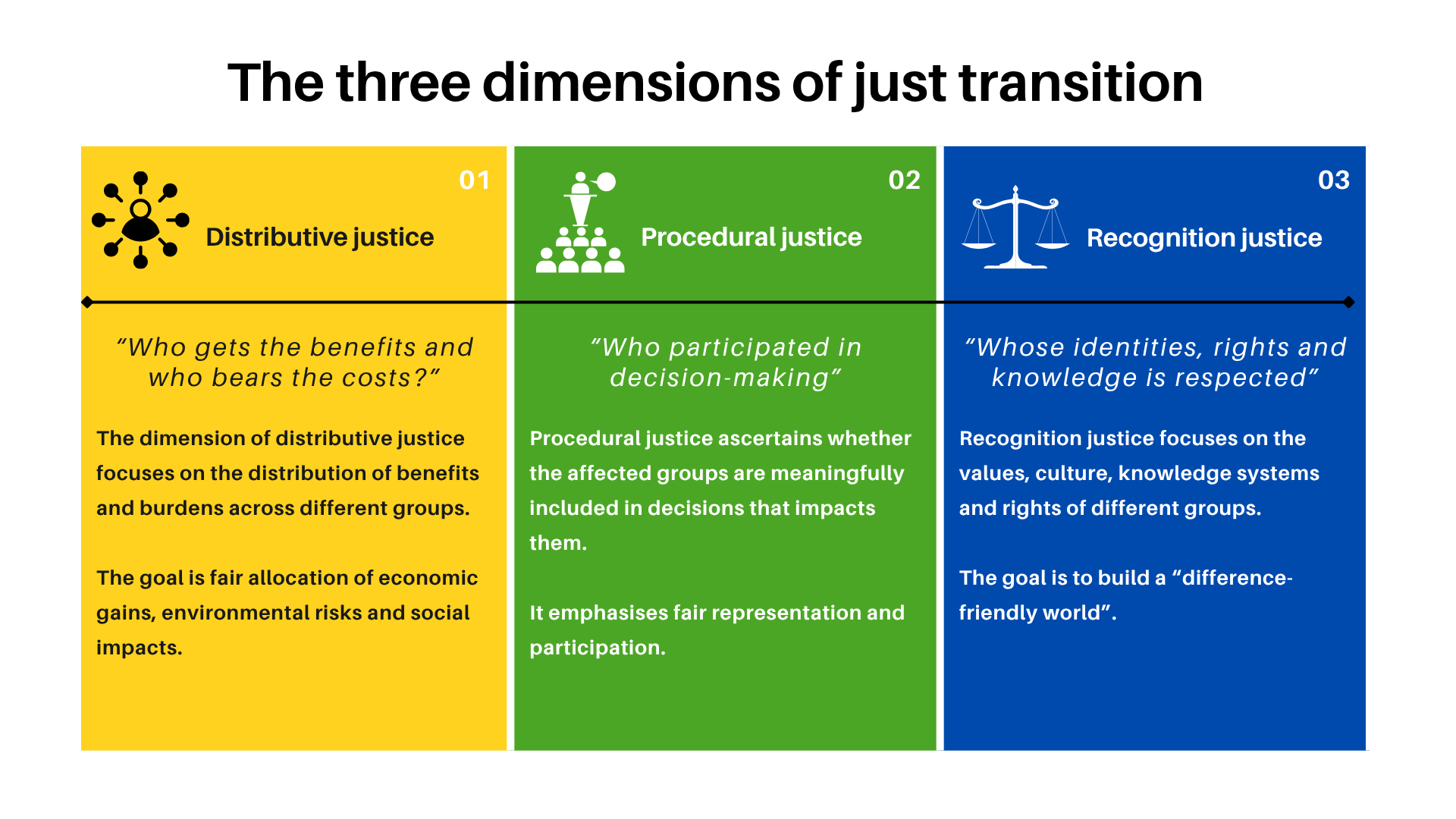
With respect to critical minerals, a just transition[1] may extend beyond decarbonisation and encompass three interconnected dimensions of justice: (1) distributive justice, with equitable benefit-sharing, (2) procedural justice, ensuring inclusive participation, and (3) recognition justice that acknowledges and safeguards community rights (Figure 2).
Figure 2. The three dimensions of a just transition
Source: Wijsman.et.al 2022
Applying these three dimensions of justice to critical minerals supply chains will require recognising the trade-offs. As discussed, a balance must be maintained between community rights, mineral security and environmental protection. This, in turn, requires a systematic approach where justice is integrated into governance frameworks by conducting early assessments and analyses of social and employment impacts, as well as acknowledging the rights and needs of local and Indigenous communities.
A gradual green transition is inevitable; however, the question that remains is whether it will also be sustainable. Treating social, environmental, and governance factors as important preconditions for defining the success of the green transition can build trust between the government, industries, and local communities. Doing so would strengthen the credibility of critical minerals governance, supporting the long-term durability of energy transition policies.
Extracting minerals from beneath the ground is a one-time choice, but how they are governed is a choice with lasting impact.
By Rati Verma, Research Consultant, Climate and Sustainability Initiative (CSI). Views expressed are personal.
Endnotes
[1]A just energy transition requires equitable distribution of benefits and burdens, grounded in inclusive processes and decision-making. Furthermore, it is also committed to addressing the challenges experienced by affected and marginalised groups, as well as preventing and repairing harm that may occur during the transition (IRENA, 2026).