
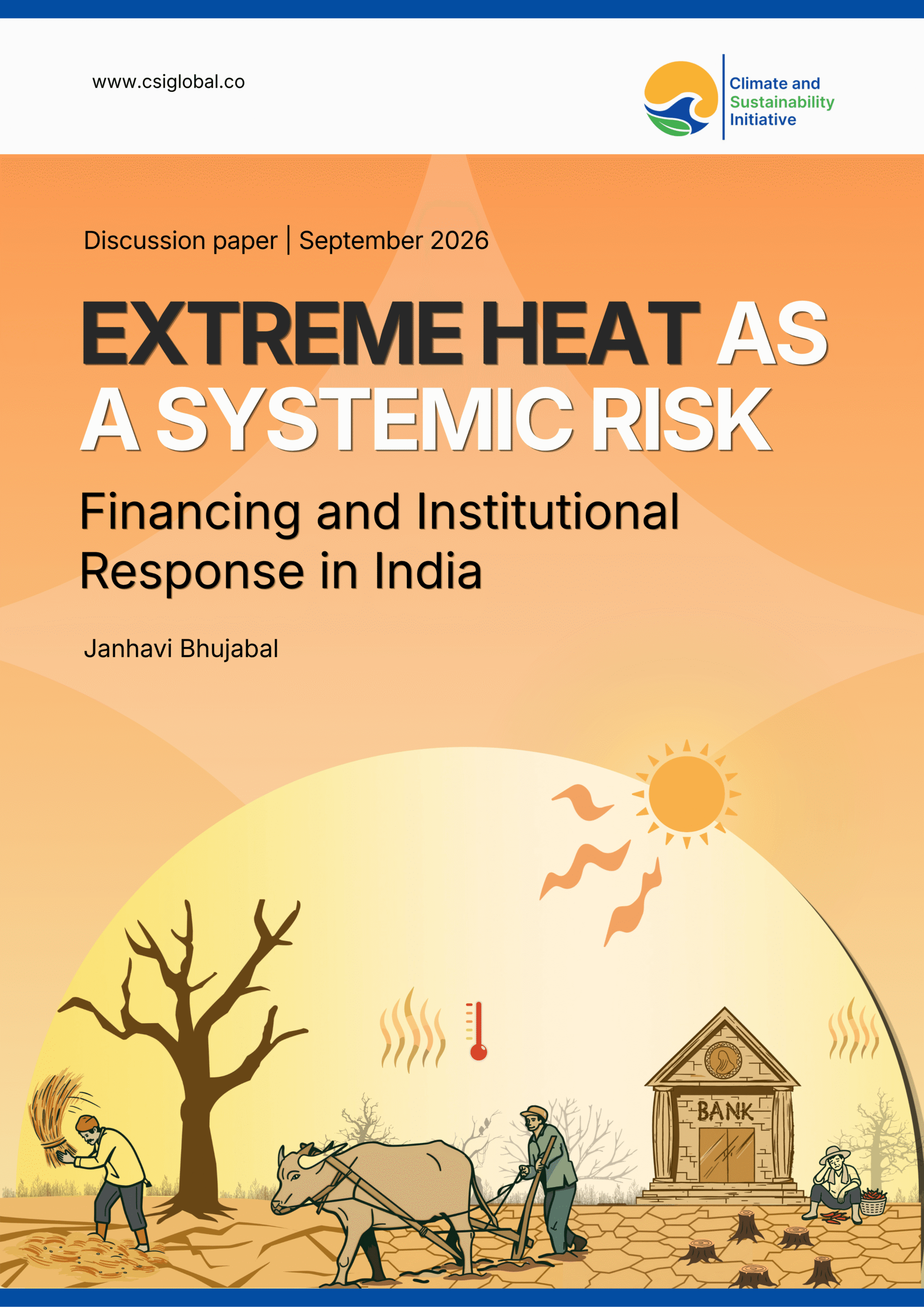
Extreme Heat As A Systemic Risk: Financing and Institutional Response in India
Janhavi Bhujabal
Context
India has made significant progress in strengthening its response to extreme heat over the past two decades. What began as a response to recurring heatwave-related mortality has gradually evolved into a broader architecture of Heat Action Plans (HAPs), early warning systems, public health preparedness, and institutional coordination, establishing an important foundation for managing seasonal heat risks across states and cities. At the same time, the focus of heat governance is broadening beyond managing heatwaves as acute disaster response events, towards a wider consideration of the risks associated with extreme heat over time. Extreme heat is growing to be recognised as a systemic risk, with implications for public health, labour productivity, water security, urban infrastructure, energy systems, and economic activity, requiring coordinated responses across multiple institutions. Recent studies indicate that India is among the world’s most heat- vulnerable economies. With climate projections indicating that these temperature trends will only escalate over the coming decades, extreme heat is no longer a temporary seasonal stressor, but a structural crisis demanding sustained, multi-generational interventions. While India’s preparedness architecture has evolved considerably, many of the emerging challenges associated with extreme heat now relate to long-term implementation, institutional ownership and financing. The next stage of heat governance is not to replace this framework but to extend it, connecting existing systems to the planning, budgeting and investment decisions that will shape heat exposure over the coming decades.
About the Paper
This discussion paper builds on earlier work by the Climate and Sustainability Initiative (CSI) on the evolution of India’s heat governance, examining the design and implementation of heat action plans (HAPs) in India with a focus on urban jurisdictions (CSI, 2026) and investigating the financial challenges (CSI, 2026) associated with long-term heat resilience. A brief overview of this research series is annexed to the paper as background reading. The paper also draws on insights from a closed-door roundtable held on 21 August 2026 and one-on-one discussions with practitioners and experts in disaster management, public health, meteorology, urban planning, infrastructure, climate policy and finance. The discussions centred on how India’s response to extreme heat can evolve from seasonal preparedness against heatwaves to longer-term resilience and mitigation. The paper synthesises these discussions to provide recommendations for the next stage of heat governance.
