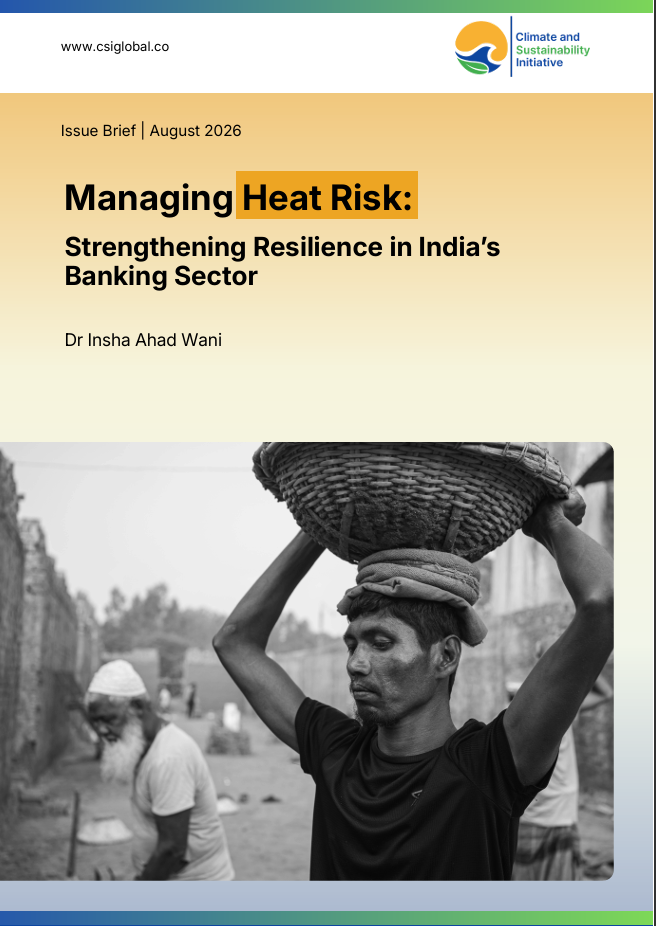
Managing Heat Risk: Strengthening Resilience in India’s Banking Sector

Aug 20, 2026 | Policy Brief

Dr Insha Ahad Wani

Heat Policy Brief_Cover Image

Key Insights

1. Extreme heat is emerging as a material financial risk for Indian banks. Nearly a quarter of bank credit (24.36%) is directed to labour-intensive, heat-exposed sectors such as agriculture and construction, and over 70% of total credit flows to just 11 states with the highest heat-risk exposure, concentrating vulnerability across both sectors and geographies.

2. Despite growing evidence linking heat stress to rising delinquency and eroding asset quality, Indian banks remain largely unprepared in practice, with weak heat-specific underwriting and credit and liquidity stress testing. Climate disclosure also remains rhetorical rather than operational.

3. Heat-proofing India’s banking system requires action on two fronts simultaneously. One, banks must build internal resilience through heat-sensitive risk monitoring, portfolio diversification, and stronger capital buffers. Two, the state and regulators must reduce borrower-side vulnerability through well-funded heat action plans, early-warning systems, and scalable parametric heat insurance.

Author

  • Dr Insha Ahad Wani

    Dr. Insha Ahad Wani is a Consultant at the Climate and Sustainability Initiative (CSI), where she works to strengthen CSI’s analytical and external positioning by translating rigorous research into clear, credible, and policy-relevant insights. At CSI, she supports the development of white papers, newsletters, and blogs, and contributes to research initiatives related to climate finance, sustainability, and development challenges. Her role involves background research, drafting, and synthesis, helping teams frame evidence-based narratives that align with CSI’s strategic priorities and stakeholder needs. She works closely with internal teams to support research dissemination and thought-leadership efforts.

    Insha brings a strong foundation in finance and development research, with particular expertise in financial inclusion, gender, and sustainability. Her doctoral research examined the role of microfinance in women’s empowerment in Jammu and Kashmir, combining empirical analysis with socio-economic perspectives. Her broader research interests include development finance, climate vulnerability, and the role of financial systems in advancing sustainable development outcomes. She has published multiple papers in peer-reviewed national and international journals and has presented her research at academic conferences.

    Before joining CSI, Insha held teaching and research positions at institutions including the University of Delhi and Delhi Technological University, where she taught courses in commerce and finance. She has also been associated with externally funded research projects focused on women’s inclusion and regional development, which strengthened her experience in applied research and policy engagement.

    Insha holds a PhD in Commerce from the Delhi School of Economics, University of Delhi, with a specialisation in finance, along with postgraduate and undergraduate degrees in commerce. Her academic training is complemented by experience in both quantitative and qualitative research methods.

    Outside of work, Insha enjoys reading non-fiction and exploring new ideas through books. She finds creative expression and relaxation in cooking and embroidery, and values time spent connecting with nature.