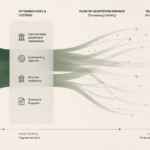
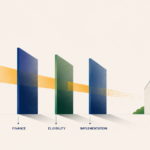
The Baku to Belém Roadmap to 1.3T (2025), launched at the meeting of the Parties to the Paris Agreement during its sixth session (CMA 6) of COP30,[1] envisages developing an actionable framework for scaling climate finance to developing countries in the short and medium term. The report aims to scaling climate finance flows to USD 1.3 trillion annually by 2035, building on earlier commitments, including the near-term climate finance support of USD 300 billion.
The Roadmap comes at a time of deep structural changes in the global climate finance architecture, with rising global capital costs and private finance exits from net-zero alliances. While the ambition is welcome, its financial realism needs to weigh in the changing geopolitical order to be feasible, particularly as major advanced economies, such as the US and the EU, reassess their climate commitments.
More importantly, the report states that the Roadmap is dependent, inter alia, on international cooperation and should not be interpreted as an attempt to prejudge the Party-driven process of implementing decisions under the New Collective Quantified Goal on Climate Finance (NCQG). The report thus risks undermining the significance of predictable, concessional public finance from advanced economies as a precursor to climate finance flows to developing countries. With so many “shoulds” and “coulds”, and no clear “musts” in the potential solutions proposed, the Roadmap risks becoming a road less travelled.
The 5Rs: useful categories, but need clarity on the execution
The 5Rs—Replenish, Rebalance, Rechannel, Revamp, and Reshape—form the backbone of the Roadmap, offering a coherent framework for diagnosing bottlenecks. However, the proposed approach to their execution reveals inconsistencies.
- Replenishing: The report recognises the fragmented climate finance landscape and proposes enhanced coordination across multilaterals, philanthropies, and development banks for enhancing concessional and low-cost finance through bilateral and multilateral channels.
- Rebalancing: This section acknowledges debt vulnerabilities and fiscal space and suggests potential climate-linked debt solutions or frameworks that could enable developing countries to have greater access to concessional finance without worsening their debt dynamics.
- Rechannelling: The report highlights the need for de-risking instruments and regulatory reforms necessary to crowd in private finance. The proposed mobilisation of USD 650 billion in cross-border private finance is aspirational, but the market evidence—especially post-NZBA[2] withdrawals—suggests that a more cautious baseline may be warranted.
- Revamping and reshaping: These sections correctly highlight access bottlenecks and capacity constraints, as well as the need for macro-prudential policy reforms to increase cross-border investment flows to developing countries.
In sum, the report rightly emphasises “replenishing” and “rechannelling” funding flows, calling for expanded concessionality, SDR[3] rechannelling, and stronger balance sheet optimisation by the multilateral development banks (MDBs). It estimates that MDBs could provide USD 390 billion in climate finance by 2030 if reforms are fully implemented. The Roadmap, however, misses out on critical structural adjustments needed to prioritise climate and nature targets within government budgeting processes and to reduce finance flows to nature-negative sectors, including fossil fuels.
The five pillars (5Rs) offer clarity on potential incremental supply, allocation, and structural barriers within climate finance flows. Nevertheless, the report over emphasises on additional funding sources rather than structural reallocation of existing ones. The report thus gives limited importance to the political economy of capital markets, fossil-dependent cash flows, and nature-related risks.
A strong narrative of urgency, but limited attention to structural adjustments
The report rightly points out that the cost of inaction is escalating faster than investment needs, with global losses from climate-related disasters reaching USD 320 billion in 2024. It underscores that capital stock remains misallocated, flowing simultaneously towards fossil expansion and climate action. More importantly, the report flags the paradox that high capital costs drive divestment from emerging markets, but it offers few mechanisms to reverse this tide. Without embedding risk-adjusted return corrections—through prudential regulation, sovereign credit recalibration for climate vulnerability, and well-designed nature-related disclosures with proportional requirements—capital outflows from developing regions will continue.
Nature finance and nature-based solutions: strong language but weak financial pathways
The lack of structural corrections becomes more visible in the report’s limited approach to nature finance, which is highly susceptible to the same risk-pricing challenges highlighted above.
The report recognises that nature degradation magnifies systemic risk and that financing nature-based solutions (NbS) is central to adaptation, food system resilience, and emissions reduction. In financial terms, however, NbS are treated as a thematic add-on rather than a structural investment category. Despite acknowledging that nature investment in developing countries needs to grow to USD 250 billion annually by 2030 and USD 350 billion by 2035, the report does not suggest a quantified pathway for nature finance within the 1.3T architecture. More importantly, given the report’s emphasis on systemic shifts—highlighting the role of information sharing through various networks and reporting standards—it is surprising that it does not mention the efforts of the Taskforce on Nature-Related Financial Disclosures and the urgency to integrate nature-related financial risks into the cost of capital discussions.
Political feasibility versus financial necessity
A deeper reading of the Roadmap suggests a tension between political feasibility (what countries may agree to) and financial necessity (what the climate economy system may need). This is most evident in the treatment of global taxation proposals, including airline levies, maritime fees, wealth taxes, and financial transaction taxes, which are acknowledged but largely left to “interested countries”. Similarly, Special Drawing Rights (SDR) rechannelling is presented as a major lever; yet legal constraints within the IMF have already slowed progress, and the Roadmap does not outline a plan to resolve these structural bottlenecks.
A valuable framework, but not yet a blueprint
The Baku to Belém Roadmap to 1.3T does attempt to synthesise stakeholder inputs for a more coherent climate finance system. However, as a roadmap, its proposed financial mechanisms need refinement. While the report acknowledges nature and its economic centrality, these considerations are not structurally embedded within the framework.
For the 1.3T goal to be meaningful, the climate finance architecture must evolve from mobilising more capital to moving capital differently—away from nature-negative, fossil-dependent systems and towards regenerative, adaptive, and community-anchored economic transitions. In our guess, that is a leap the Roadmap gestures towards but does not yet deliver.
By Honey Karun, Economist, Climate and Sustainability Initiative (CSI). Views expressed are personal.
Footnotes
[1] The 30th United Nations Climate Change Conference of the Parties, held in Belém, Brazil, in November 2025.
[2] Net-Zero Banking Alliance, an initiative launched in 2021 to help global banks align their lending with the goal of achieving net-zero emissions by 2050. The alliance ceased its operations in August 2025.
[3] Special drawing rights are an international reserve asset (equivalent to the value of a basket of selected world currencies) maintained by the International Monetary Fund (IMF).
References
United Nations Framework Convention on Climate Change. (2025). Baku to Belém Roadmap to 1.3T. https://unfccc.int/sites/default/files/resource/Relatorio_Roadmap_COP29_COP30_EN_final.pdf