India’s current residential rooftop solar capacity accounts for roughly just 27% of its total rooftop capacity (Nexdigm, 2025). In a country where households vastly outnumber factories, this statistic reflects that rooftop solar has consistently been easier to finance at scale for commercial consumers than for ordinary homeowners.
By 2022, India had achieved only about half of its national target: to install 100 gigawatts (GW) of solar capacity by that year (Gulia, Thayillam, & Garg, 2022). Growth in rooftop solar capacity has seen stretches of stagnation due to a combination of financial and structural barriers, including supply-chain disruptions and a lack of targeted public policies with sufficient financial incentives. The present PM Surya Ghar: Muft Bijli Yojana (PMSG:MBY) is a step in the right direction to tackle these challenges. Nevertheless, future expansion of residential rooftop capacity needs to overcome several structural bottlenecks, which calls for action that goes beyond financial support.
The scheme offers Central Financial Assistance (CFA)[1] subsidies by system size, up to a maximum of ₹78,000 for a 3 kW system. The aim is to incentivise consumers to adopt rooftop solar systems. It does not look to cover the entire cost; the balance financing is expected to come from bank loans or personal savings. The headline number for the scheme has been encouraging: 26.38 lakh installations (MNRE, 2026). Yet, despite disbursing nearly ₹18,000 crore under CFA as of March 2026, the scheme has solarised only about 30% of its target households. Sources show just 22 out of every 100 applications resulted in a completed installation (IEEFA, 2025; Economic Times, 2025), a trend that warrants closer examination of the reasons for the slow uptake.
A recent report by the Council on Energy, Environment and Water (CEEW) analysed the demand side of the PMSG: MBY scheme and recommended strategies to boost consumer awareness and market uptake. In contrast, this analysis explores the supply angle. Beginning with the assumption that consumers are genuinely interested, we assess potential operational or design inefficiencies and identify critical bottlenecks that could prevent the scheme from realising its full potential.
Bottlenecks to expansion
The seventh report of the Parliamentary Standing Committee on Estimates (2025–26) on the Ministry of New and Renewable Energy, titled Implementation of Pradhan Mantri Kisan Urja Suraksha Evam Utthaan Mahabhiyan (PM-KUSUM) & PM Surya Ghar: Muft Bijli Yojana (2025), offers a useful diagnostic entry point.
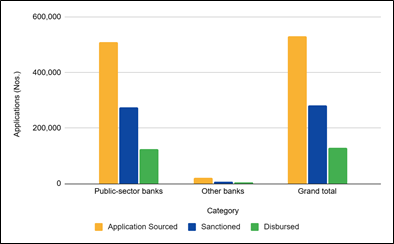
The loan data tabled before the committee is striking (see Figure 1): across all participating public-sector banks, 5,31,199 applications were received, 2,82,240 were sanctioned, and loans were ultimately disbursed for only 1,29,463 applicants (Parliamentary Standing Committee on Estimates, 2025). That is a disbursement rate of roughly 24% of applications received—meaning, for every four households that initiated the loan process, three did not receive funds. A public bank that was one of the scheme’s lending partners received 2,52,496 applications, but it disbursed loans only to 36,753 applicants—a conversion rate of less than 15%. Understanding and addressing this glaring gap between applications and disbursement will be crucial to the success of PMSG: MBY (and, indeed, any other ambitious scheme hoping for widespread reach across India).
In addition, uptake among private banks is significantly lower than in public banks, for a few possible reasons that are worth exploring:
- In rural markets, customer acquisition and operating expenditure demand a greater outlay. Combined with a small ticket size (as with PMSG: MBY loan products), the unit economics become unattractive for private banks.
- The scheme mandates collateral-free loans, effectively making them too financially risky for private banks.
Figure 1: Loans applied, sanctioned. and disbursed under PMSG: MBY through public and private banks as of September 2025
Eligibility bottlenecks
The MNRE identified a primary cause for the poor loan disbursal: a verification conflict, where the name on the electricity bill differs from that on the legal property title. This halts standard banking workflows, because lenders must legally link the physical asset (the rooftop system) to the consumer’s electricity savings.
This is, however, an administrative hurdle rather than a structural one. Lenders could resolve this using existing proxy-verification tools, such as an affidavit or a no-objection certificate (NOC) from the owner, which legally bind the consumer to the property, satisfying the bank’s “Know Your Customer” (KYC) and risk protocols without requiring households to formally amend utility meter ownership or proxy verification tools, as explored in schemes such as the Pradhan Mantri Jan-Dhan Yojana (PMJDY) (SBI, n.d.).
However, a second eligibility constraint cuts deeper. According to the MNRE, in rural India, house ownership is often undocumented, or property is held informally, making it difficult to verify collateral under standard credit-underwriting norms. This concern is exacerbated by the fact that the Ministry of Statistics and Programme Implementation’s records approximately 26.5 crore households nationally, of which nearly 70% are rural. The scheme’s primary demographic, therefore, is most likely to be excluded due to documentation-based eligibility criteria, making this a design contradiction that demands targeted reform of implementation norms in rural India.
Structural bottlenecks
The urban side of this picture presents another binding constraint. For 8.49 crore urban households, the physical feasibility of installing individual rooftop solar systems is the binding limit rather than documentation. The scheme’s technical specifications require a shadow-free area sufficient for a 3 kW system. While this may be readily available on independent houses, rooftop space is considerably more constrained in multi-storey urban housing, where roof area is shared by multiple residents. The scheme’s own CFA structure for group housing societies acknowledges this by capping eligible capacity at 3 kWp per household, calculated using the number of units in the building, recognising that a single rooftop cannot proportionally serve every unit below it once a building exceeds a certain height or density. This is further complicated by the fact that housing societies usually don’t have multiple electricity connections from the discom; they have a single connection for the entire society, which then distributes the electricity.
The numbers are also indicative of this. Apartments and condominiums now account for 71% of India’s residential construction market (Mordor Intelligence, 2025). However, a standard 3 kW system requires roughly 150–200 sq ft of shadow-free roof area (Servotech, 2026), space that most flat owners in mid-rise or high-rise buildings neither individually control nor benefit from. The scheme’s subsidy architecture, in short, is calibrated for a housing structure that is rapidly becoming the minority in India’s highest-consumption urban markets.
Financing bottlenecks
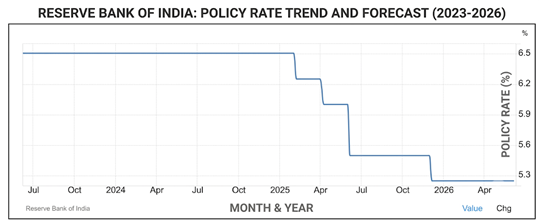
The scheme sets the interest rate at repo + 50 basis points (bps)[2], which currently stands at 6.50% for a loan with a 10-year tenure, no collateral, and no processing fees when obtained through a few public banks (Parliamentary Standing Committee on Estimates, 2025).
The collateral-free structure is a progressive move. However, as the rate moves with the monetary policy, the effective cost of accessing the scheme fluctuates with the Reserve Bank of India’s (RBI’s) policy-rate decisions—which have nothing to do with household energy-saving decisions. A fixed concessional rate, or a rate corridor, may insulate the scheme from such rate-cycle noise and also offer households more predictable repayment economics and greater confidence to apply for loans. Figure 2 shows fluctuations in the repo rate for FY 23-26, illustrating the reality that repo rates are not stable within a comparatively short time frame.
Figure 2:
The way forward
Despite these gaps, the trajectory of the PMSG: MBY is highly encouraging. The scheme evidently has potential for greater uptake at the household level, given the savings generated by this renewable energy system. It also stands to benefit states as a whole, easing tariff-subsidy burdens in the long run. However, to realise many of these benefits, solutions to the above bottlenecks must be explored.
A possible solution to the documentation mismatch problem is to introduce a self-declaration mechanism with Aadhaar-linked verification. This could resolve many cases at minimal cost. For rural households with informal ownership, land-revenue records, panchayat-issued certificates, or community attestation could be recognised as valid documentation, thereby aligning the scheme’s eligibility framework with how property is actually held across rural India.
On financing, some interventions could structurally widen access and are worth exploring:
- Replace the repo rate–linked interest calculation with a fixed concessional rate.
- Establish a dedicated solar credit–guarantee fund that would give banks the confidence to lend to households or individuals with thin credit histories.
- Instead of relying purely on the Credit Information Bureau (India) Limited (CIBIL) score, underwrite the loan against the rooftop solar system’s projected economic output, using estimates of electricity bill savings to demonstrate loan repayment capacity.
The PMSG: MBY has demonstrated genuine demand, with over 1 crore registrations and a tenfold increase in average monthly installation rates. The scheme’s bottlenecks are not born of a lack of ambition or interest; they are architectural.
Fixing the eligibility framework, insulating loan pricing from monetary policy cycles, and building financing instruments suited to how Indians actually live and own property are not major refinements, but quite achievable. These are the preconditions for this scheme (or any other similar scheme) to reach the households it was designed to serve.
By Aditya Sharma, Research Intern, Climate and Sustainability Initiative (CSI).
Endnotes
[1] Central Financial Assistance (CFA) is a direct subsidy provided by a federal or central government to support specific infrastructure, social welfare, or renewable energy projects
[2] The repo rate (repurchase rate) is the interest rate at which the central bank lends money to commercial banks when there is a shortage of funds.