Raghu woke up early and turned off the aerators in the ponds on his two-acre property, preparing to feed the shrimp. As he started rowing his boat, his wife called. “The boy’s family called,” she said. “They want to fix the wedding venue this week. Come home soon.” He replied that he would soon be back.
He started rowing again and noticed some shrimp floating on the surface of a pond. He scooped one up to check for discolouration.
“It’s WSSV,”[1] he exclaimed, hurrying to his other pond to see if the infection had spread to it. He had dealt with similar outbreaks several times before.
As he made his way to his storage hut, Raghu tried to figure out how he would repay the loans from his three previous failed production cycles, totalling nearly INR 5 lakh.
His daughter’s wedding was only weeks away. He sat staring at his phone, which showed four missed calls from his wife. He looked out at the still pond in despair.
“Why did I get into this business?”
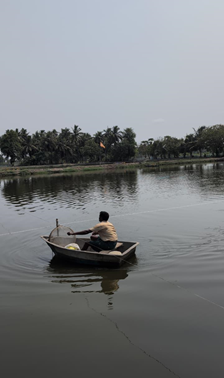
Figure 1. A small-scale farmer rowing his boat to feed shrimp
Raghu is one of the millions of small-scale aquaculture farmers in India, and his question is not merely personal but one that warrants a policy response (Ravisankar et al., 2025). WSSV alone can wipe out an entire shrimp crop within three to ten days, causing annual losses of INR 1,670 crore (USD 238.33 million) in India (Patil et al., 2021). However, most farmers have nowhere to turn when a crop fails. Insurance penetration in Indian aquaculture remains very low (FAO, 2022).
Background and context
India is the world’s second-largest aquaculture producer, with the sector accounting for 68% of its aquatic food production (MFAHD, 2026). It supports the livelihoods of approximately 30 million people, most of whom are small-scale farmers (Das, Gupta, & Gulati, 2026). Shrimp exports increased from 150,000 tonnes in 2010 to 800,000 tonnes in 2023, generating USD 7.38 billion in seafood export earnings in 2022–23. This growth has been driven mainly by rising demand, particularly from the US and China (MPEDA, 2011, 2023; FAO, 2022). Yet many shrimp-farming households remain economically precarious, with thin farm-gate margins and little protection against trade policy fluctuations (Minhaz, 2025; Economic Times, 2025). This export orientation is not accidental. In India, aquaculture has traditionally been regulated through commerce and trade frameworks rather than food and agriculture policy. As a result, the sector developed with a structural bias towards export performance over farmer welfare (Kurien, 2004).
Divergent support systems: agriculture vs aquaculture
Despite its significance for livelihoods, food security and exports, aquaculture remains vulnerable in terms of both production and public finance, especially compared with the closely related agricultural sector. Table 1 highlights the differences in institutional support available to the two sectors in India.
Table 1. Institutional comparison between the agriculture and aquaculture sectors in India
| Support mechanism | Agriculture | Aquaculture |
| Minimum support price (MSP) | Presenti | Absentii
|
| Extension services | Extensiveiii
| Limitediv
|
| Crop insurance schemes | Presentv
| Limited and weakvi
|
| Subsidy ecosystem | Strongvii | Uneven accessviii |
| Climate adaptation missions | Presentix
| Emerging and fragmentedx |
Source: Author’s own compilation using various sources
Notes: i. MAFW (2025); ii. Minhaz (2025); iii. Economic Times (2025); iv. MAFW (n.d.); v. FAO (n.d.), PMMSY (n.d).; vi. UNDP (n.d.); v. PIB (2025); vi. Ravisankar et al. (2025); vii. Fifteenth Finance Commission (2021); viii. Anrooy (n.d.); ix. PIB (2025); x. Ravisankar et al. (2025).
Aquaculture accounts for approximately 1.1% of India’s gross domestic product (GDP) and is growing at around 10% annually—about four percentage points faster than the overall agricultural sector (Ravisankar et al., 2025). Yet this growth has not translated into better returns for farmers. Much of the expansion has been driven by growth in export demand and consolidation among large operators, while small-scale farmers face rising input costs, disease outbreaks and limited financial protection.
Although the MSP system is far from adequate during seasons of widespread crop failure, it nevertheless provides rice and wheat farmers with a degree of income protection (Minhaz, 2025; Economic Times, 2025). Aquaculture producers, by contrast, have no comparable price floor mechanism to fall back on. The Pradhan Mantri Matsya Kisan Samridhi Sah-Yojna (PM-MKSSY), introduced in 2023–24, encourages the uptake of aquaculture insurance by subsidising insurance premiums (PMMSY n.d.). However, the primary focus of subsidy schemes in aquaculture is one-time capital infrastructure & modernisation, as opposed to agriculture, which is continuous operational inputs & price stability (MoAFW n.d.) When shrimp prices collapsed following US tariffs, state-level relief, power tariff cuts and loan moratoriums were directed primarily at exporters and processors; many primary producers reported that they were largely overlooked (The Federal, 2026).
Key vulnerabilities in aquaculture
Aquaculture insurance penetration remains critically low. Commercial insurers avoid high-risk markets, and the substantial losses caused by WSSV and other pathogens have led many insurers to withdraw coverage for disease-related crop failures from aquaculture insurance products, leaving farmers exposed to their single greatest risk. Since disease is the most frequent and devastating cause of loss in shrimp farming, this exclusion renders insurance largely ineffective and contributes to low uptake (Hohl, 2021). Despite this exclusion, premiums for aquaculture insurance products have historically remained very high, ranging from 4.5% to 7.5% for aquaculture compared with 2.5% for agriculture (The Fish Site, 2009; Hohl, 2021). Shrimp farming is also highly capital-intensive, with production costs of around USD 20,700 (approximately INR 17 lakh) per hectare per crop (Ravisankar et al., 2025). The lack of meaningful insurance cover, combined with the capital-intensive nature of aquaculture, leaves farmers vulnerable to a vicious cycle of high risk and low affordability, with virtually no safety net. While some formal loan schemes exist, such as farm credit through the National Bank for Agriculture and Rural Development (NABARD) and the National Cooperative Development Corporation (NCDC) under the Pradhan Mantri Matsya Sampada Yojana (PM-MKSY), access is limited, and debt burdens can become severe when crops fail (NABARD, 2024). In contrast, agricultural loans are more widely supported, with occasional moratoriums during periods of distress (Ministry of Finance, 2019). The financing gap makes aquaculture ventures disproportionately risky.
These financial vulnerabilities are compounded by climate and biological threats. Cyclones can destabilise coastal farms, while floods and heat stress affect both coastal and inland operations (FAO, 2024; Patil et al., 2021). Disease outbreaks, particularly WSSV, remain endemic (Patil et al., 2021). Although research by the Central Institute of Brackishwater Aquaculture (CIBA) and the National Fisheries Development Board (NFDB) has improved biosecurity by introducing measures such as polymerase chain reaction (PCR) screening and specific pathogen-free (SPF) seeds, many small-scale farmers cannot afford to adopt these practices (Van Anrooy et al., 2022).
Here lies the deepest contradiction. India’s export growth depends on compliance with stringent food safety standards set by the EU, US and Japan (MPEDA, 2026), and consignment rejections are treated as a national crisis. Institutions such as the Marine Products Export Development Authority (MPEDA), the Export Inspection Council (EIC) and state-level laboratories provide accredited testing and certification services in India. However, these services are primarily oriented towards exporters and processors rather than primary producers. The biosecurity protocols, pond-level compliance requirements and input standards needed to meet export requirements ultimately translate to additional cost pressure throughout the supply chain. Exporters pass these costs on to producers by demanding lower farm-gate prices, effectively shifting the economic burden of compliance onto smallholders operating on borrowed capital with no financial safety net (Subasinghe, Soto, & Jia, 2009).
Policy fragmentation and governance gaps
Whether seeking post-disaster compensation, insurance claims, market support or basic licensing, a shrimp farmer must navigate multiple institutions, including the National Fisheries Development Board (NFDB), the Agriculture Insurance Company of India (AIC), the Marine Products Export Development Authority (MPEDA) and the state fisheries department, each with its own procedures, deadlines and eligibility criteria. For a farmer like Raghu, this fragmentation is effectively exclusion by design (Bavinck et al., 2014).
Conclusion
India cannot continue to be the world’s second-largest producer of seafood while relying on farmers who lack institutional support, meaningful insurance and price protection. The growth of India’s export-oriented aquaculture industry and Raghu’s debt are equally genuine. However, reframing aquaculture as a livelihood sector rather than an export industry will require practical institutional reforms. This entails, at the very least, integrating aquaculture into India’s food security policy framework; establishing a single nodal coordination body across the MPEDA, NFDB and AIC to reduce institutional fragmentation; and providing disease-inclusive crop insurance for all aquaculture farmers. As long as those who cultivate the sea cannot afford to feed their own families, India’s aspirations for a sustainable blue economy will remain hollow.
The blog is authored by Yashita Singhi, Consultant at Climate and Sustainability Initiative (CSI). The views expressed here are the author’s alone.
Endnotes
[1] White Spot Syndrome Virus (WSSV) is a highly contagious and lethal double-stranded DNA virus that targets crustaceans, particularly penaeid shrimp