India’s climate ambitions necessitate significant capital investments in the energy, transportation and industrial sectors. According to various estimates, India will require about USD 10–22 trillion to achieve net-zero emissions by 2070 (CSI, 2026). Banks, as the primary providers of credit in the economy, play a central role in mobilising this capital. Lending is thus of paramount importance. Whether banks are lending adequately to the green sector, and where exactly they are lending, are crucial questions. Several Indian banks voluntarily disclose their green- or sustainable-finance portfolios. However, a deeper assessment of such disclosures reveals gaps in how this information is presented: no two banks report on precisely the same parameters, and there is considerable variation in the basket of activities they report on.
This creates a disclosure landscape that prevents regulators or investors from making meaningful use of the data provided. At the heart of this problem is a critical gap in financial infrastructure: the absence of a formal climate finance taxonomy that defines which activities banks may include in their green disclosures, along with a classification framework for consistent reporting.
What the numbers actually show
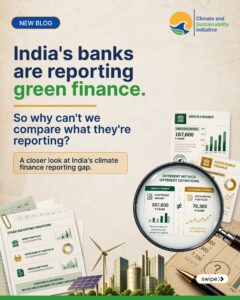
One way commercial banks can help address climate risk is by lending to climate-aligned sectors. Several banks in India disclose such credit lines in their annual reports and investor presentations. However, the way this reporting is done is often inconsistent, as Table 1 shows.
Table 1: Green- and sustainable-finance disclosures by select Indian banks (FY 2025–2026)
| Bank | Heading used | Metric type | Amount (INR ’000 crore) | What it means |
| State Bank of India (SBI) | Sustainable finance | Sanctioned limit | 167.6 | Maximum credit approved, not necessarily the amount deployed |
| HDFC Bank | Green portfolio | Outstanding portfolio | 78.3 | Money actually lent, covering solar, wind, biogas, electric vehicles (EV) and green buildings |
| ICICI Bank | Sustainable/green portfolio | Outstanding portfolio | 99.4 (31% green) | Reports the green component separately within the larger sustainability book; the green component covers renewable energy, EVs, green buildings, and green hydrogen |
| Kotak Mahindra Bank | Green asset book | Outstanding portfolio | 9.9 | Anchored to the RBI’s Commercial Banks – Climate Finance and Management of Climate Change Risks Directions, 2025 (RBI, 2025) |
| Axis Bank | Green lending portfolio | Outstanding portfolio | 45.5 | Sectors not specified |
| Punjab National Bank (PNB) | Sustainable finance | Sanctioned | 22.8 | Disaggregated by product, covering renewable energy, EVs, and solar rooftops |
Source: Annual reports and investor presentations of SBI (FY 2026), HDFC Bank (FY 2026), ICICI Bank (FY 2026), Kotak Mahindra Bank(FY 2026), Axis Bank (FY 2026), and PNB (FY 2026).
The first issue is that “green finance” and “sustainable finance” are not conceptually the same. “Sustainable finance” is an umbrella term that encompasses financing for environmental as well as social and governance goals. Meanwhile, “green finance” refers only to the capital invested to achieve environmental objectives. Since banks report using different terminologies, it is unclear whether they are referring to the same activities. For example, ICICI Bank’s disclosure is the most precise (see Table 1) – it explicitly reports the “green financing” component separately within its broader “sustainability” portfolio.
The second issue is the difference between sanctioned limits and the outstanding portfolio. “Sanctioned limits” refers to the maximum amount that can be approved (not the actual credit used), while “outstanding portfolio” refers to the actual amount loaned. The two represent entirely different metrics. Yet, consider the two biggest banks in India: the State Bank of India (SBI) reports its sanctioned limit, whereas HDFC Bank reports its outstanding portfolio – and these two metrics are not comparable.
The third issue is the lack of an anchoring regulation applicable to all. The only bank on this list that aligns its green asset book with a regulatory body is Kotak Mahindra Bank, which aligns it with the RBI’s Commercial Banks – Climate Finance and Management of Climate Change Risks Directions, 2025 (RBI, 2025). While Kotak Mahindra adopted these reporting norms of its own accord, every bank ought to be mandated to follow the same approach.
The comparability problem
Comparison of banks’ operations is critical for regulators and policymakers. How much funds has each bank allocated to climate-aligned sectors? Has this investment increased over time or decreased? How does one bank’s climate commitment compare to another’s? These are fundamental questions that the current disclosure landscape fails to answer.
Because there is no common system of classification, different banks have developed their own definitions, measurement standards, and ways of presenting information. These systems may work well enough at the level of the individual bank. However, at the sectoral level, the information presented remains opaque to comparison and therefore cannot meaningfully support decision-making and governance. As a result, monitoring the progress of green finance in India becomes difficult.
A standardised reporting system should be mandated, covering at minimum: the total outstanding portfolio amount committed to green finance categories, not just the amount sanctioned; a sector-wise categorisation of the flow of capital and yearly directional data, indicating whether capital flows to each sector have increased or decreased, so that data across banks can be compared. Only then will policymakers be able to track where capital is actually flowing, identify gaps, and make informed regulatory decisions.
The missing taxonomy
These issues can be directly traced to the lack of a formal climate finance taxonomy. The Draft Framework of India’s Climate Finance Taxonomy published by the Ministry of Finance (2025) takes a big stride in this direction. It proposes a classification system that categorises activities in the power, mobility, building, agriculture, and hard-to-abate sectors as either “green” or “transition”. The window for public comments closed in June 2025, and the country now awaits a final, binding version of the taxonomy.
There are tangible costs associated with this wait, however. As per an estimate published by the National Institution for Transforming India (NITI Aayog), it will cost around USD 22.7 trillion (cumulative investment) to decarbonise all key sectors of the economy by 2070 (NITI Aayog, 2026). In the absence of a common taxonomy, it is difficult to measure the mobilisation of capital towards this goal.
What other taxonomies deliver
Other major economies have already moved on this. The European Union’s Taxonomy for sustainable activities was adopted in 2020 and provides a binding classification system that defines for banks, investors and regulators which activities qualify as “environmentally sustainable” (European Commission, 2020). China’s climate finance taxonomy, the Green Finance Endorsed Project Catalogue, 2025, unifies standards for green loans, bonds, and insurance; it also clearly defines which economic activities and investments qualify as “environmentally sustainable” (China’s State Council, 2025).
Table 2: Green asset ratio (GAR) disclosures by select EU banks (FY 2025–2026)
| Bank | Sustainable assets (stock, € million)[1] | GAR (stock)[2] | GAR (flow)[3] |
| BNP Paribas | 23,417 | 6.92% | 6.47% |
| Banco Santander | 43,150 | 3.17% | 3.29% |
| Société Générale | 12,205 | 1.71% | 0.97% |
| Natixis (BPCE) | 670 | 0.30% | 0.09% |
Source: Universal registration documents and annual financial reports of BNP Paribas (2025), Banco Santander (2025), Société Générale (2025) and Natixis (BPCE) (2025).
EU banks report a common metric called the “green asset ratio”, which is calculated the same way by every bank per the EU Taxonomy (Table 2). This means that BNP Paribas’ 6.92% and Société Générale’s 1.71% can be directly compared, which is currently not possible for any two Indian banks. Banks are also required to report their “stock” and “flow” figures, showing not just how green a bank’s book is currently, but whether new lending is greening faster or slower than before.
Table 3: Green loan disclosures by China’s ‘big four’ banks (FY 2025–2026)
| Bank | Green loan balance (¥T) |
| Industrial and Commercial Bank of China | 6.70 |
| China Construction Bank | 6.00 |
| Agricultural Bank of China | 5.93 |
| Bank of China | 4.96 |
Source: Annual reports of Industrial and Commercial Bank of China (2025), China Construction Bank (2025), Agricultural Bank of China (2025) and Bank of China (2025).
Chinese banks each publish their outstanding green loan balances in their annual reports. China’s climate finance taxonomy provides a clear definition for what counts as “green”, in contrast to the Indian disclosures landscape, which currently has a high rate of ambiguity. The People’s Bank of China also collects institution-level data from all banks and publishes one national figure, so that regulators can easily track the sector’s progress as a whole, rather than piecing together individual reports to draw their own conclusions. India has neither piece of this system in place: no shared definition for banks to report against, and no central body to compile the numbers.
The way forward
The vision of India reaching net zero by 2070 cannot be achieved without a financial system capable of tracking and measuring the flow of climate-aligned capital. India’s Draft Climate Finance Taxonomy passed the public consultation stage over a year ago (Ministry of Finance, 2025). The Ministry of Finance must finalise and release the taxonomy without any further delay. In the interim, the RBI must set minimum disclosure requirements for banks to disclose their green and transition finance in a common format. This is the bare minimum required for a functioning green finance system.
By Ayushi Kalra, Research Intern, Climate and Sustainability Initiative (CSI).
Endnotes
[1] Sustainable assets (stock): the absolute euro value of loans, bonds and equity holdings that a bank classifies as “Taxonomy-aligned”.
[2] GAR (stock): the share of a bank’s total outstanding loans, bond and equity holdings that finances activities that meet the EU Taxonomy’s criteria for being “environmentally sustainable”.
[3] GAR (flow): the share of new lending that originates in the reporting year and is taxonomy-aligned (this is a directional metric, showing whether a bank’s lending is greening faster or slower than its existing book).