Rising temperatures, dense built-up areas, and changing climate patterns have elevated extreme heat from an occasional disaster situation into a force that strains how Indian cities function, bringing increased mortality, productivity losses, and health burdens. As these impacts intensify and recrudesce,[1] governments are shifting from reactive crisis management to strategic preparedness, through heat action plans. This blog series traces the evolution of heat governance in India from recognising heat as a predictable and recurring risk, to the broader adoption of heat action plans, and finally to the challenges associated with financing heat action.
In the first part of this series, we provide the historical context for how heat has moved onto the policy agenda, explain why urban governments are central to the response, and trace how heat action plans have taken shape and scaled across Indian cities as the key instrument for managing climate risk.
What is a heatwave?
The Intergovernmental Panel on Climate Change (IPCC, 2022) characterises a heatwave as “periods of abnormally hot weather, often defined with reference to a relative temperature threshold, lasting from two days to months”. Unlike sudden shocks such as cyclones or floods, heat builds up slowly over time. Its impacts are not immediate, making them less visible even as they intensify for people and systems (IFRC, 2022). However, prolonged exposure to heat (Marcotullio et al., 2022) can push human, infrastructural, and institutional systems to their limits, influencing how heat is experienced and managed.
How has heat emerged as a policy concern?
As scientific and public health evidence grew, extreme heat gradually made its way into policy discussions. Early assessments conducted by the IPCC from the 1990s onwards[2] established that rising global temperatures will increase the frequency, intensity, and duration of extreme heat events. These findings indicated that heat exposure will become a recurring aspect of climate change, although it initially took a backseat to more visible hazards.
Public health research raised heat as a policy concern by the early 2000s. Epidemiological studies in Europe and North America documented linkages between heatwaves and excess mortality, particularly among older populations and individuals with pre-existing conditions (Hajat et al., 2002; Kovats & Hajat, 2008). These findings gained policy visibility following severe events, most notably the 2003 European heatwave, which resulted in over 70,000 deaths (Robine et al., 2003) and provoked institutions such as the World Health Organization (WHO, 2008) to issue formal heat health-response guidance,[3] marking an early shift toward directing systemised policy attention to rising temperatures.
Early responses to heat focused less on long-term climate planning and more on preparedness and prevention. Internationally, this was shaped by public health frameworks such as that of the WHO (2008), which emphasised early warning systems, communication, and the readiness of health services as core elements of heat response, while allowing for local adaptation. However, international frameworks (WHO & WMO, 2016)[4] gradually reframed extreme heat as a cross-sectoral risk that extends to urban services and labour systems, helping consolidate preparedness into what has now been standardised globally as Heat Action Plans.
Indian context: From recognition to response, how heat action took shape
In India, heat gained policy attention primarily through recurrent experiences. Heatwaves in the late 1990s and 2000s caused many deaths, with official records reporting thousands of heat-related fatalities over the years.[5] The extent of risk became very clear during the 2015 heatwave, which led to over 2,000 reported deaths (NDMA, 2022). This reinforced the idea that extreme heat is a serious and ongoing threat, and not just an isolated emergency.
Alongside mortality, early research linked heat exposure to reduced labour capacity, which showed that high temperatures limit safe working hours in outdoor occupations (Kjellstrom, Holmer & Lemke, 2008). This is particularly true for economies such as India’s, with large informal workforces. Alongside frequent extreme events, this evidence redefined heat as a predictable social risk. It laid the groundwork for more structured policy responses.
The effects of heat were concentrated in cities, which came to be regarded as areas of higher risk. High population density and concrete environments intensify temperatures through the urban heat island effect[6]. This increases the urban temperature relative to surrounding areas, prolonging heat stress. Evidence from India shows that cities are warming nearly twice as fast (0.53°C vs 0.26°C per decade) as nearby rural regions (Sethi & Vinoj, 2024).
India’s heat response changed significantly after severe heatwaves in 1998. Odisha became the first state to introduce heat management measures (Dasgupta et al., 2024). As heat gained visibility within national disaster management and public health frameworks, more synchronised approaches emerged at the city level — for instance, Ahmedabad’s Heat Action Plan of 2013 (Knowlton, 2014). This plan extended the municipal heat response beyond health preparedness to include urban measures such as public cooling, water access, work advisories, and departmental coordination (IIPH & NRDC, 2014; 2019). Recognition of heat within formal disaster management processes, supported by guidance from the National Disaster Management Authority (NDMA, 2017),[7] helped embed heat preparedness within state, district, and local administrations.
The evolving landscape of heat action plans in India
The broader adoption of heat action plans accelerated after the late 2010s (see Figure 1), extending from large metropolitan areas to Tier-2 cities and smaller towns, as well as entire districts.[8]
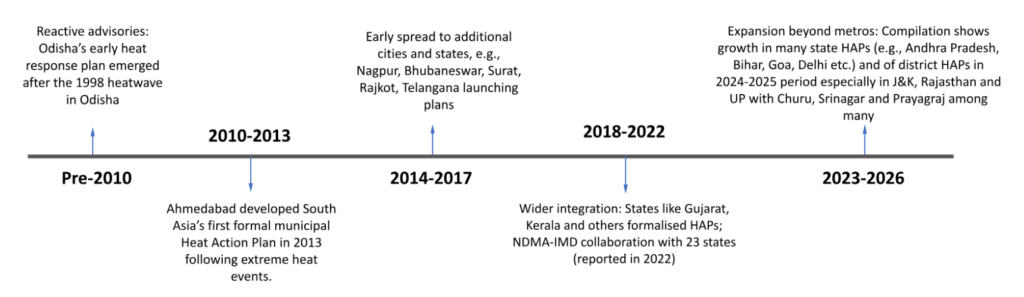 Figure 1. Timeline: From early city-led projects to their wider adoption across states and districts, this chart traces the development of heat action plans over time. Sources: Dasgupta et al 2024; Knowlton et al 2014; CDKN 2016; PIB 2022; IRADe 2021; The Analysis 2025; NRDC 2025; Prayagraj HAP 2024; Srinagar HAP 2024
A recent district-level assessment of heat risk (Figure 2) shows that 57% of Indian districts fall within the ‘High’ or ‘Very High’ risk categories, with the maximum concentration in the central and western regions.[9]
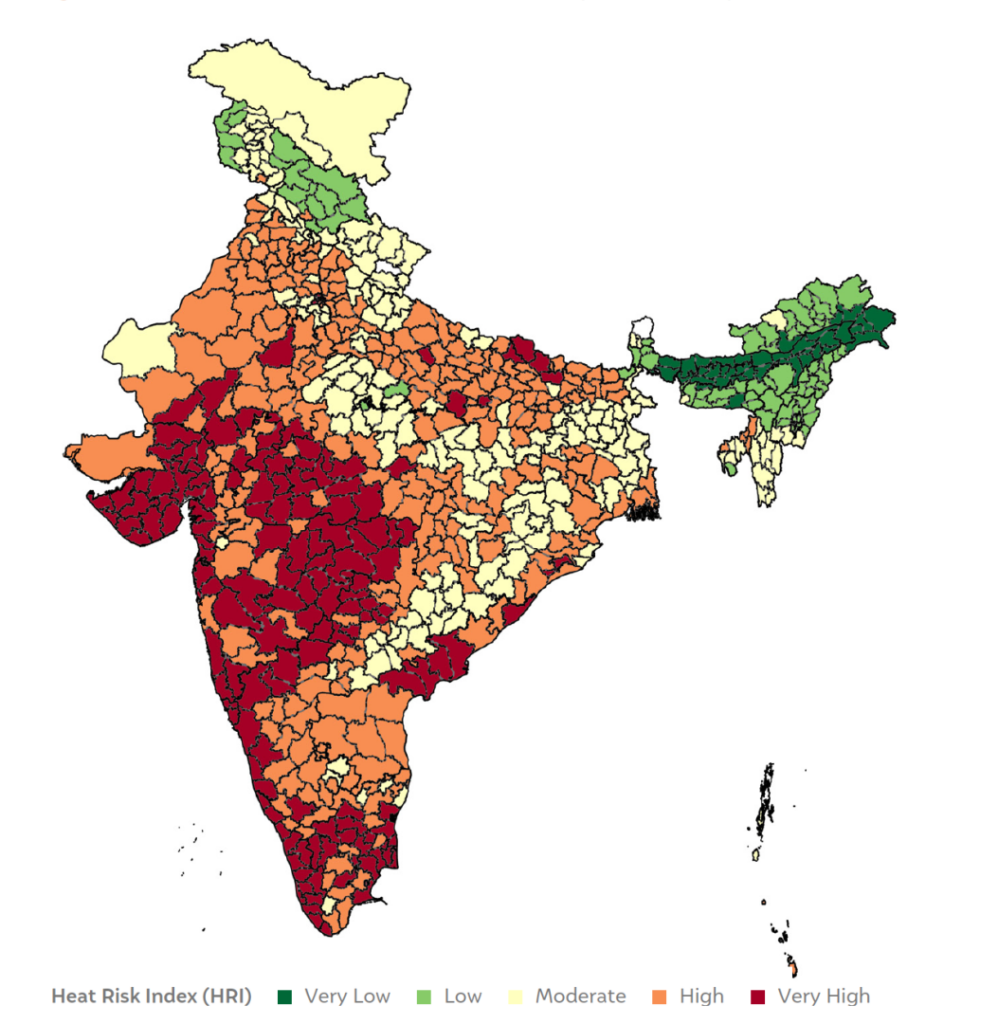
Figure 2. District-level Heat Risk Index (HRI) across India, highlighting the concentration of ‘High’ and ‘Very High’ heat-risk districts. Source: CEEW (2025)
The geographical distribution of risks and the spread of institutional responses are reflected spatially across states, districts, and cities (Figure 3).
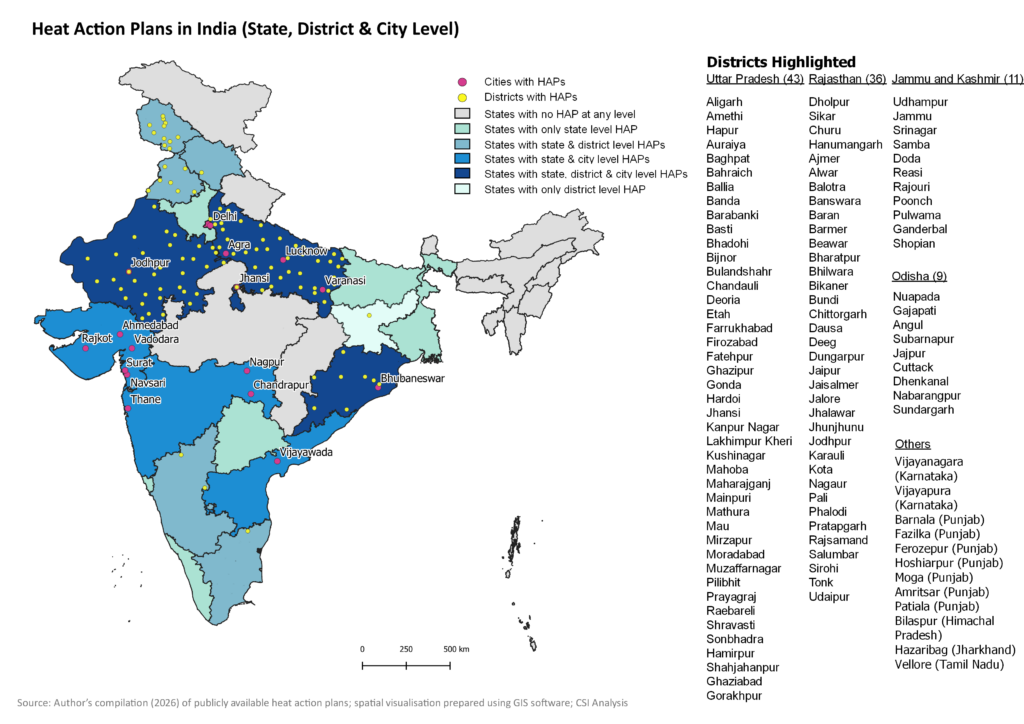 Figure 3. Heat Action Plans in India (at the state, district and city/municipality levels) as of February 2026. Source: Author’s compilation (2026) of publicly available heat action plans; spatial visualisation prepared using GIS software.
By outlining responsibilities across sectors such as health, labour, water, and urban services, most heat action plans combine public communication, preparedness of public health systems, resilience of urban infrastructure, and inter-departmental coordination, reflecting a common understanding of heat as a multi-sectoral risk, in line with NDMA (2017; 2019) guidelines. Notably, differences across plans emerge in their degree of emphasis, scope, and administrative scale — whether at the city, district, or state level (CPR, 2023).[10]
The proliferation of heat action plans thus reflects the shift in heat risk management in administrative practice across India. Yet their expansion does not solely reveal how these plans function on the ground. Questions on how the heat action plans are implemented, how responsibilities are structured within them, and how heat preparedness is financed have become crucial as plans scale.
Conclusion
It is encouraging to see the policy shift over time on how extreme heat has moved from being addressed through emergency measures to a recurring policy concern requiring planned preparedness over time. As this architecture grows, greater attention must be focused on how these plans are implemented and funded. The next blog builds on this overview to examine these dimensions in greater detail.
By Janhavi Bhujabal, Consultant, Climate and Sustainability Initiative (CSI). Views expressed are personal.
Footnotes
[1] The Lancet Countdown for India (Lancet, 2024) and de Bont et al. (2024) show a 50% rise in loss of labour hours to heat since the 1990s, with vulnerable urban groups hardest hit and heatwaves linked to 14.7% higher mortality in 10 cities with rising frequency/intensity.
[2] The IPCC’s First Assessment Report (1990) and Fourth Assessment Report (2007) identified increasing heat extremes linked to rising global temperatures.
[3] WHO’s EuroHEAT project (2008) issued policy guidance on heat health action plans for Europe in the aftermath of the 2003 heatwave crisis.
[4] The joint WHO and WMO Heat Health Guidance (published in 2015, but documenting 2011–13 work) established multi-sectoral heat response standards (health + urban services + labour coordination), influencing Ahmedabad’s pioneering 2013 Heat Action Plan after the 2010 heatwave-related deaths in the city.
[5] The National Disaster Management Authority noted (via NRDC 2019) 24,223 heat-related deaths recorded in India over 1992–2015, showing sustained annual mortality through the 1990s and 2000s.
[6] Urban heat island describes the tendency for urban areas to be warmer than rural areas because of heat-retaining materials such as concrete and asphalt, reduced vegetation and waste heat from increased human activity (Oke, 1982)
[7] The National Heat Wave Guidelines of 2017 formalised heat as a disaster management priority, providing states with a comprehensive framework (of early warnings, inter-agency coordination, vulnerability assessment, health preparedness, etc.,) that embedded heat preparedness across state and local administrations.
[8] NRDC (2019) showed that the success of Ahmedabad’s Heat Action Plan (1,100+ deaths avoided annually) catalysed the scaling of similar plans to 23 states and 100+ cities/districts by 2019, establishing a multi-sectoral standard for heat action plans nationwide.
[9] CEEW’s (2025) mapping of heat risk across 734 Indian districts used a composite Heat Risk Index that combined hazard (temperature trends, heatwave frequency, night-time temperatures, and humidity), exposure (population and built-environment characteristics), and vulnerability (health, socio-economic and adaptive capacity) indicators.
[10] CPR India’s analysis covered 37 heat action plans across 18 states and revealed variations on the administrative scale (9 city, 13 district, and 15 state plans).